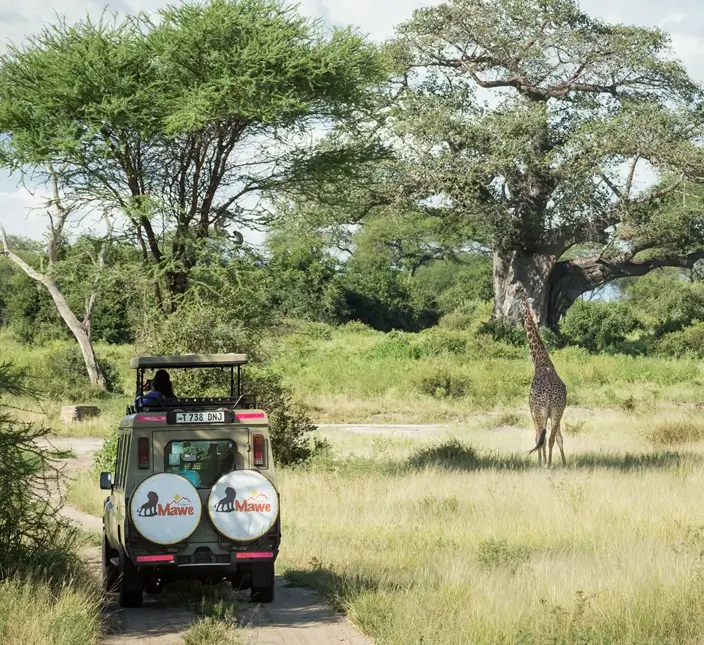
Big cats safari in Tanzania
Most visitors treat a big cat sighting as luck. On a big cats safari in Tanzania it is mostly ground. Lions hold the kopjes, because granite gives them shade and a view over the plains. Leopards keep to the river lines, where trees give them cover and somewhere to store a kill. Cheetahs need short grass, because they chase their prey down and they have to see it first.
Camera-trap research puts Serengeti leopards at about 5.4 for every 100 square kilometers (39 square miles). That is a spread-out population rather than a small one. So a leopard rewards the right route instead of more hours in the vehicle. Our camp at Soit Le Motonyi is the one property in our collection with all three cats resident in the same area, every month of the year.
Which big cats live in Tanzania
A big cat is any member of the genus Panthera plus the cheetah, which gets counted with them by size and by habit. In Tanzania that means three animals: the lion (Panthera leo), the leopard (Panthera pardus) and the cheetah (Acinonyx jubatus).
Two smaller cats matter on a trip built around predators. The serval (Leptailurus serval) hunts rodents in long grass and gives itself away with a vertical pounce. The caracal (Caracal caracal) is scarcer, nocturnal, and known for taking birds out of the air. You will not plan a trip around either. You will remember them if you get one.
Tiger, jaguar and snow leopard do not occur in Africa. Neither does the African golden cat, which belongs to the forests of West and Central Africa rather than to any Tanzanian park.
Lion, leopard and cheetah
Lions and the ground they hold
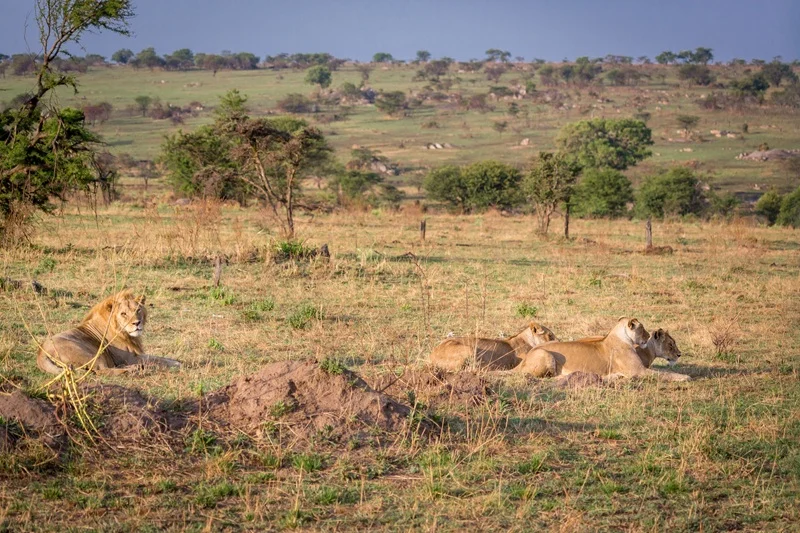
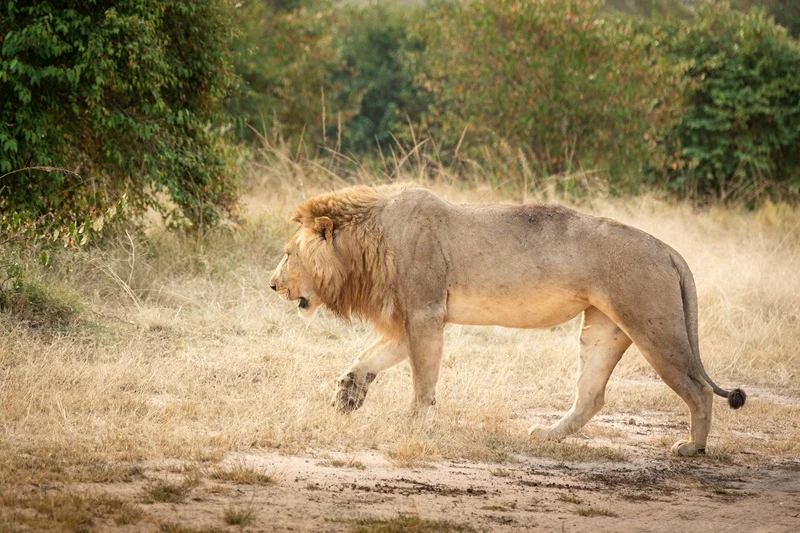
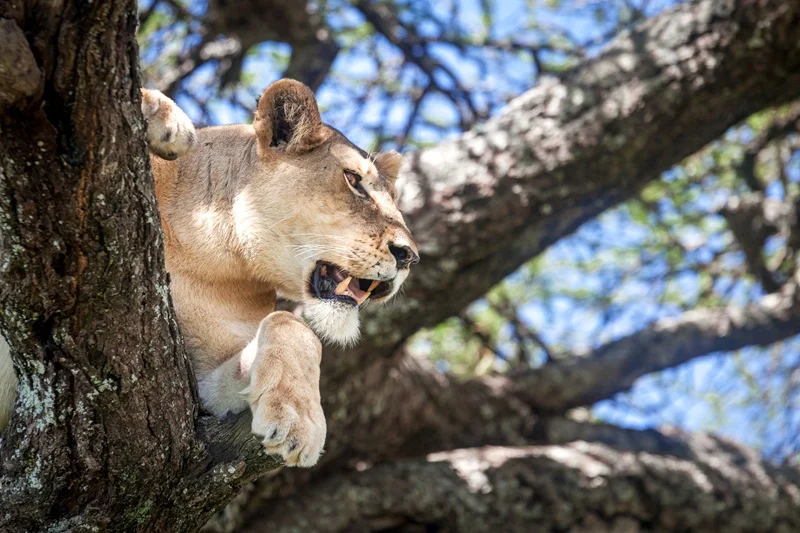
Lions pick their ground for shade, vantage and ambush. Granite kopjes give all three, which is why a pride will use the same rocks for years. In the middle of the day they move into woodland edges. In Tarangire they work the corridor where elephants and buffalo pass.
The Ngorongoro Crater is the exception on the circuit. The walls keep a resident population in one place, so an early descent gives you the shortest odds of the trip. Our escarpment lodge thirty minutes from the crater gate exists for that early start.
One male made the east Serengeti prides famous with our guests. Bob Jr, also called Snyggve, held territory near the Sametu Kopjes close to our camp. Guests asked for him by name. He lost his territory and his life to an incoming coalition on 10 March 2023. Our guide Bony Maro watched it happen while working with a group of photographers. His story is on the blog, and it explains lion territory better than any general description.
Leopards and why the river lines matter
Camera-trap work published in Biodiversity and Conservation in 2020 put Serengeti leopard density at 5.41 for every 100 square kilometers in the dry season and 5.72 in the wet. Both figures carry wide credible intervals, and both come from the Snapshot Serengeti project rather than from a guess.
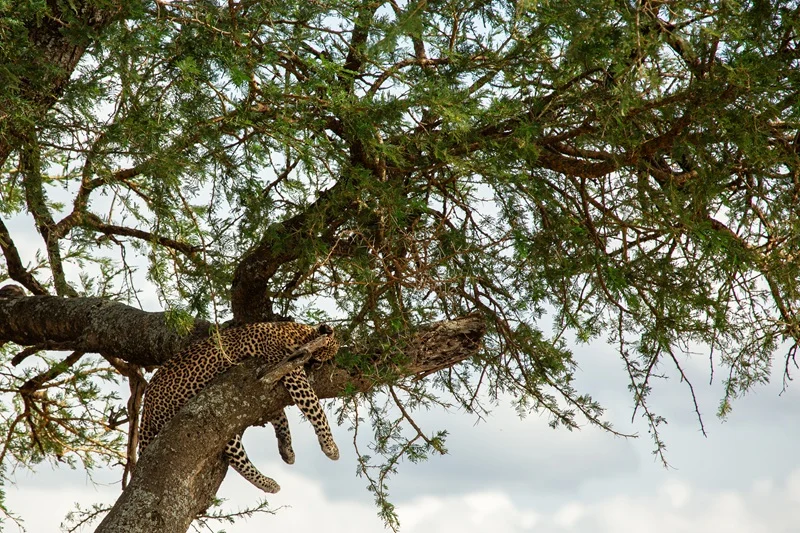
That number changes how you should plan. A leopard is not rare in the Serengeti. It is thinly and evenly spread, and it sleeps through the hours you are driving. So the route matters more than the mileage. Drive the river lines and the big trees along them, slowly, and stop to look up.
Our camp at Soit Le Motonyi is on the Ngarenanyuki River, and leopards hold those river lines year round. Lake Manyara adds a different angle, because its lions climb trees and its groundwater forest is leopard ground as well.
Cheetahs and the short grass
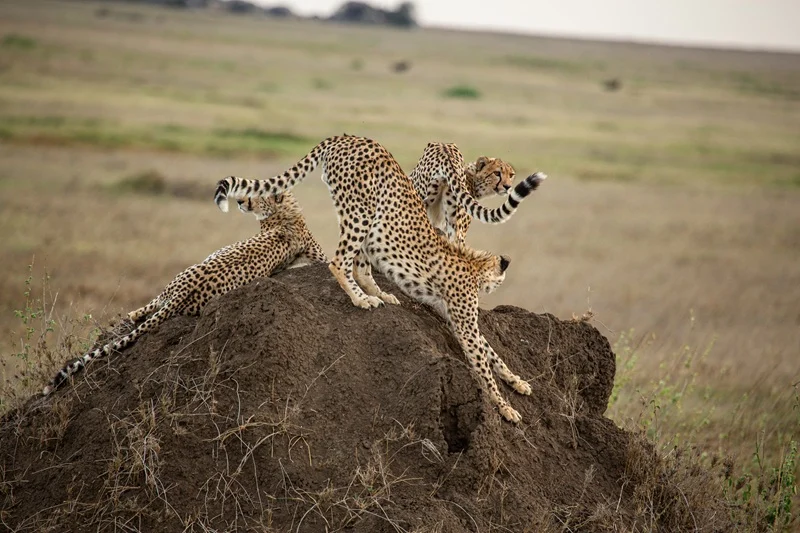
The Serengeti Cheetah Project has monitored the southern plains since 1974, working with the Zoological Society of London, the Wildlife Conservation Society, TAWIRI and TANAPA. Their count for those plains is around fifty adult females and twenty adult males at any one time.
Name the study area, because that figure covers the southern short grass plains and not the whole park. It also explains the animal. A cheetah needs open ground, and open ground is a small share of the Serengeti.
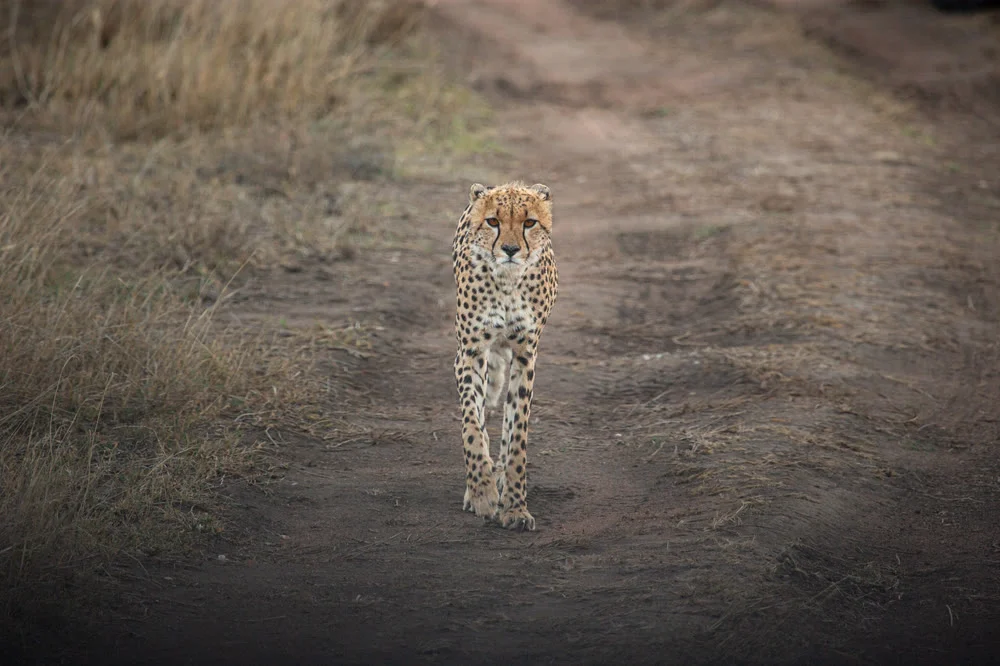
Short grass gives a cheetah a clear run and gives you a clear view of it. In the same conditions you will watch a hunt develop for several minutes rather than catch the end of one.
A note on speed, because the number gets repeated wrongly. GPS collars on wild cheetahs in a real hunt recorded about 93 kilometers per hour (58 miles per hour), published in Nature in 2013. The same study found that hunts are won on acceleration and on the ability to turn, not on top speed. Watch the shoulders, not the straight line.
Where to go on a big cats safari in Tanzania
Six places on the northern circuit carry cats worth building a trip around. We operate in all of them, which is why this list stops where our vehicles stop. Ruaha, Nyerere and the southern parks hold cats too, and we do not sell them.
The central-eastern Serengeti around Soit Le Motonyi is where the short grass plains meet acacia woodland. That edge gives you three cats in one drive: cheetahs on the open ground, lions on the kopjes, leopards along the river lines. Researchers have worked the eastern Serengeti cheetah population for decades, and the area stayed closed to visitors for a long stretch while they did.
The Seronera valley in the central Serengeti holds water all year, so it holds prey all year. Leopards use the fig and sausage trees along the river. It is the busiest part of the park, and a good sighting there comes with other vehicles.
Ndutu puts short grass, standing water and half a million newborn wildebeest in the same place between late January and March. Predator activity peaks there because the prey does.
Tarangire National Park works differently. The corridor between the park and Lake Burunge draws elephants daily, and lions, leopards and cheetahs move through it. Tarangire also allows night drives, and most northern parks do not.
The Ngorongoro Crater holds a small resident lion population in a closed bowl, which makes it the most reliable lion morning on the circuit. Cheetahs struggle there, because hyena clans take their kills.
Kogatende in the northern Serengeti is a river story between June and November. Crocodiles wait in the water and lions and leopards wait on the banks.
Which park suits which cat
Central-eastern Serengeti
All three
Short grass meets woodland, so three habitats overlap
All year
Seronera valley
Leopard
Permanent water and big riverine trees
All year
Ndutu plains
Cheetah, then lion
Short grass, off-road driving, and calving prey
Late December to March
Tarangire and the Burunge corridor
Lion, and cats after dark
A daily game corridor, plus night drives
June to October
Ngorongoro Crater
Lion
A closed bowl with resident prides
All year
Northern Serengeti, Kogatende
Lion and leopard
River banks concentrate both predator and prey
June to November
The cats you only meet after dark
Serval, genet and civet move at night, and so do leopards and lions once the heat goes. Most of the northern circuit shuts its gates at sunset, so almost nobody sees any of it.
Tarangire is the exception. A night game drive there leaves at about 9pm and is back in camp roughly two hours later. A spotter works the spotlight from the vehicle. Guests come back talking about the serval more than the leopard.
It costs $94.50 per person on a shared vehicle, plus a $59 per person night permit that TANAPA charges separately. Baobab Tented Camp is inside the park on the Lake Burunge corridor, so the drive starts where you are already staying.
Why off-road driving changes what you see at Ndutu
Inside Serengeti National Park you stay on the track. Ndutu is inside the Ngorongoro Conservation Area instead, and the rules there allow driving off it.
That difference shows up at the vehicle, not on a map. When a cheetah walks away from the road, you can follow her. When she settles, you can bring the vehicle low and side-on rather than looking down at her from a track. In the hour after dawn, when a chase can start well away from any road, it is the difference between watching and missing.
Gnu Ndutu Camp is open from late December to 31 March, which covers the months this matters most.
The best time of year to see big cats
There is no closed season for cats, because the resident animals do not move with the migration. Three windows are better than the rest.
Late January and February at Ndutu give you peak predator activity, because calving season puts hundreds of thousands of newborn wildebeest on open ground. June to October dries the circuit out, grass gets short, and prey concentrates at water you can predict. Between June and November the northern Serengeti river banks pull lions and leopards to the crossings.
Outside those windows the cats stay put. Our camp at Soit Le Motonyi has resident lions, leopards and cheetahs in every month, and low-season rates fall well below peak. So a big cats safari in Tanzania has no bad month, only cheaper ones. If you want the wider calendar, we cover it on the best time to visit Tanzania.
Where to stay inside cat territory
Proximity is the whole argument. A camp inside the ground the cats use gives you the first hour after dawn without a gate queue in front of it.
Mawe Tented Camp
Soit Le Motonyi, central-eastern Serengeti
All year
$182
Resident lions, leopards and cheetahs in one area
Gnu Ndutu Camp
Ndutu, southern plains
Late December to 31 March
$262
Calving-season predators and off-road driving
Gnu Mara River Camp
Kogatende, northern Serengeti
1 June to 15 November
$262
Lions and leopards on the river banks
Baobab Tented Camp
Inside Tarangire, Burunge corridor
All year
$182
The circuit’s only night drives
Karatu Tented Lodge
Rift Valley escarpment, near Karatu
All year
$101
The earliest crater descent
Every “from” figure is the low-season rate for three people sharing, full board, before park and concession fees. Karatu Tented Lodge is on this list as a crater base, not a cat camp. The cats are down in the bowl and you are up on the escarpment.
Our camp at Kogatende is 40 to 45 minutes from the Mara River crossing points.
What a big cats safari costs
A big cats safari in Tanzania costs the same as any northern circuit trip of the same length, because the cats are on the route rather than an add-on to it. We price each part separately, so you can see what you are paying for.
Camp, per person per night
$101
Full board, sharing, low season
Park and concession fees
Full-day game drive
$300 per vehicle
Private 4×4, guide, fuel
Park fees, charged by the authorities
Night drive in Tarangire
$94.50 per person
Guide, spotter, spotlight vehicle
The $59 TANAPA night permit
For a whole trip, use the published package price rather than adding these up. Our seven-day northern circuit route costs $4,360 per person for two people sharing, all-inclusive, and less per head as the group grows. The full itinerary and its pricing table are here.
Park fees are set and collected by the park authorities, separately from our rates. We explain how park fees work and who collects them.
A route built around the cats
Seven days covers the four grounds that matter without moving camp every night.
Day one brings you into Arusha. Day two takes you to Lake Manyara, where the lions climb trees and the groundwater forest holds leopards. You spend that night up on the escarpment. Days three and four put you in the central-eastern Serengeti, with a full day for the kopjes, the plains and the river lines.
Day five drops into the Ngorongoro Crater at first light for the resident prides, with Olduvai Gorge on the way out. Days six and seven finish in Tarangire on the Burunge corridor. Take the night drive on the last evening, then a morning drive before you fly.
Between late December and March, swap the Serengeti nights for Ndutu and put the off-road driving to work.
Rates include accommodation, daily game drives with picnic lunches, a guide, a private vehicle and road and airport transfers. They exclude international flights, visas, travel insurance, drinks from the bar, gratuities and any government increase in park fees.
Who this trip suits
It suits people on a second or third safari, photographers, and anyone who would rather spend two hours with one leopard than tick five species before lunch. Patience helps, and so do early starts.
It does not suit a first safari where the migration is the reason for coming. The river crossings and the cat grounds pull in different directions. It does not suit three days, either. Cats reward return visits to the same ground, and three days does not give you a second look.
Photographing big cats
The hour after dawn does most of the work. Cats are still hunting, the light is low and warm, and the vehicle throws less heat haze. Where off-road driving is allowed, get the camera down to the animal’s eye level, because a frame shot from above flattens everything.
Position beats focal length more often than people expect. A shorter lens with the cat in its ground tells you more than a tight head shot from the wrong angle. Tell your guide before the drive that this is what you are after, and they will place the vehicle for it.
On the research side, the eastern Serengeti cheetah population has been studied for decades. Access to parts of that ground has been managed around the work. We hold Travelife Gold certification, among the first mainland Tanzania properties to do so. Our DOVE Foundation work supports community projects around the parks we operate in.
Big cats safari questions
Where is the best place to see big cats in Tanzania?
The central-eastern Serengeti around Soit Le Motonyi, because short grass plains meet acacia woodland there. That edge holds cheetahs on the open ground, lions on the kopjes and leopards along the river lines. Ndutu takes over between late December and March, when calving concentrates prey and predators on the southern plains.
What is the best time of year to see lions, leopards and cheetahs?
June to October across the circuit, when short grass and predictable water concentrate prey. Late January and February at Ndutu for peak predator activity during calving. Resident cats stay put all year, so the central-eastern Serengeti works in any month, at lower rates outside peak season.
How many days do you need for a big cats safari?
Seven, at a minimum, if you want more than one ground. A big cats safari in Tanzania that covers the Serengeti, the crater and Tarangire needs two nights in each of the first and last. Five days works if you drop one park. Three gives you no second look.
Are you likely to see all three big cats on one trip?
Lions are close to certain over a week on this circuit. Cheetahs are likely on the open plains in the right months. Leopards are the one nobody honest will promise, because they are thinly spread and sleep through the middle of the day. Seven days improves your odds considerably.
Can you do a night drive to look for cats in Tanzania?
Yes, in Tarangire. Most northern parks close their gates at sunset, and Tarangire permits drives after dark. Ours leave at about 9pm and last around two hours, with a spotter and a spotlight. Serval, genet and civet are the usual reward, and leopards and lions are often on the move.
Is the Serengeti or the Ngorongoro Crater better for big cats?
The crater is better for one morning of lions, because the walls hold a resident population in a small bowl. The Serengeti is better for everything else, and for cheetahs especially. Hyena clans in the crater take cheetah kills, so cheetahs largely avoid the floor.
Tanzania · Northern Circuit
Book your stay with Mawe Lodges
Our own lodges and camps, our own guides, our own 4×4 vehicles. One team from arrival to departure.
-
12+
years operating -
Own
lodges & camps -
Own
guides & 4×4 vehicles