Tanzania · Serengeti

The Great Migration in Tanzania
The Great Migration in Tanzania happens all year. About 1.5 million wildebeest, along with zebra and gazelle, move roughly 800 kilometers (500 miles) around the Serengeti ecosystem, following rainfall to the grass it brings up.
So the question is never whether the herds are in Tanzania. It’s where they are in the month you can travel, and whether you can sleep near them when you get there.
This page answers both. You’ll find the month-by-month positions, which camps are open in each of those months, what a night costs, and a straight account of what a river crossing is like to wait for.
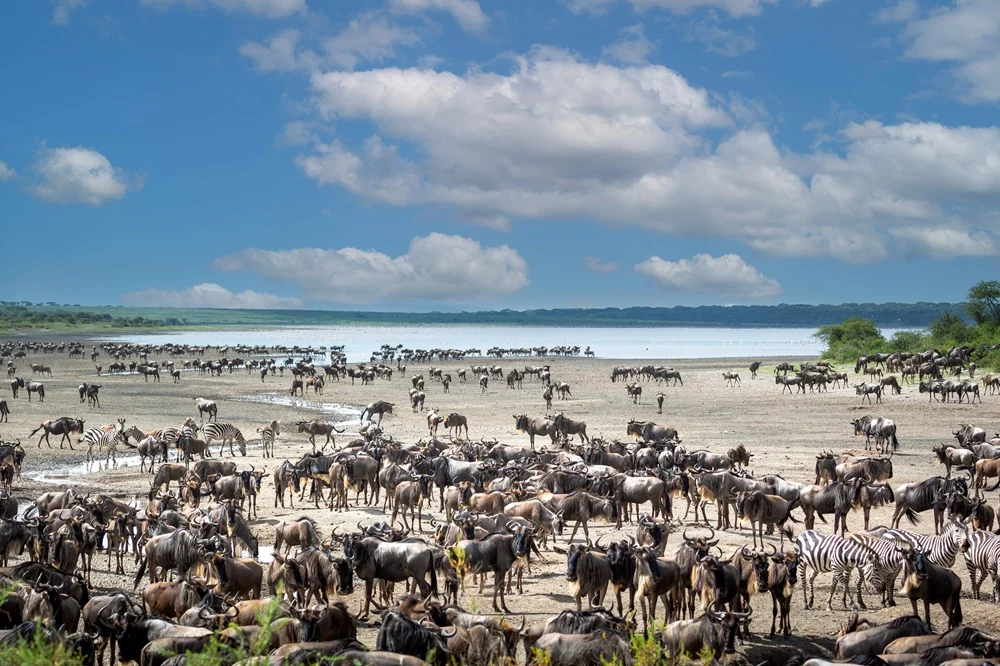
Thousands of wildebeest and zebra gathered along the shore of Lake Ndutu
Best Time

When is the best time to see the Great Migration in Tanzania?

February and August. February puts you at Ndutu for the peak of calving, when about 8,000 calves are born a day and the predators concentrate on the same plains. August puts you at the Mara River for the crossings. Both are peak-price months.
Choose between them on what you want to watch. Calving is dense, close and constant, and it happens on open plains where you can see a long way. The crossings are rarer, harder to predict and more dramatic when they happen, and you may wait two mornings for one.
If cost matters more than either, look at April, May and November. The herds are moving and harder to find, the rain is heavier, and rates and vehicle numbers both drop.
The Rain

Why the wildebeest move

The herds follow the rain. Grass grows where rain has fallen, wildebeest eat about four kilograms of it a day each, and a herd of this size strips a plain in weeks. When the grass thins, the animals move toward the next rainfall, which is why the route is a rough circle rather than a straight line north.
Two population figures circulate, and they measure different things. The most recent count found about 1.5 million migratory wildebeest in the Serengeti ecosystem, from a survey carried out in March 2023 and published in April 2024. The 2 million figure used on many safari sites adds the zebra and gazelle that travel with them. We use the wildebeest number, and you can read how the count is done.
Rainfall is not a timetable. The herds arrive early in a wet year and late in a dry one, and the windows below can shift by two or three weeks in either direction.
Month by Month

Where the herds are, month by month

January to March: calving on the Ndutu plains
Ndutu is inside the Ngorongoro Conservation Area, not inside Serengeti National Park. That changes who collects your fees, because the Ngorongoro Conservation Area Authority manages Ndutu while TANAPA manages the national park, and your permits are issued separately.
The southern short-grass plains hold the herds from late December into March. At the peak of calving, about 8,000 calves are born a day. Predators concentrate on the same ground for the same reason, so this is the densest predator activity of the migration year.
Gnu Ndutu Camp is on these plains, with 10 tents, from $262 per person. It is open from late December until 31 March, then it comes down.
One caution about timing. March is the wettest of the three months, and vehicles get stuck. In March 2026 our Ndutu team pushed a guest’s vehicle out of the mud themselves. If you want the calving without the mud, book January or the first half of February.
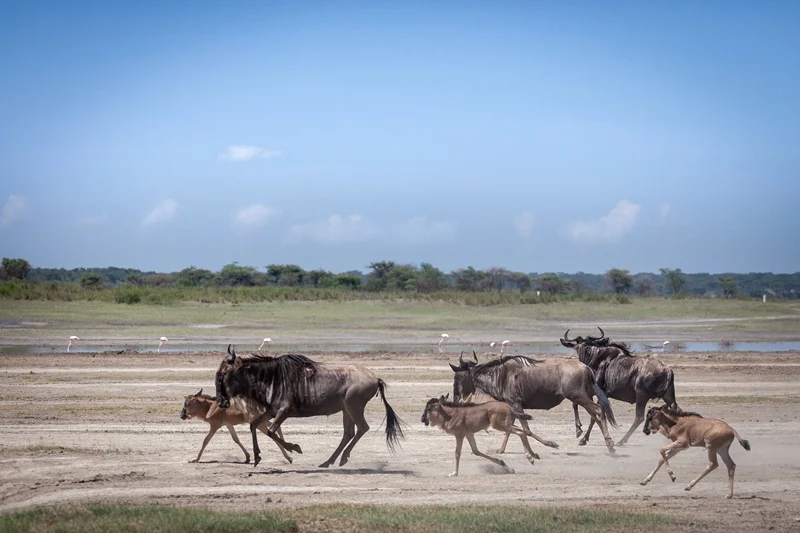
Wildebeest calves running with the herd across the open Ndutu plains
April and May

April and May: the move through the central Serengeti

The herds break into scattered groups in April and May and drift north through the central Serengeti. Rain falls most days, the grass grows long, and spotting gets harder because of it.
These are also the emptiest months on the tracks and the cheapest to travel in. Several of the best-known migration guides online skip April and May entirely, which tells you more about their booking calendars than about the wildlife.
Mawe Tented Camp is at Soit Le Motonyi in the central and eastern Serengeti, open all year, from $182 per person. The herds pass through this area in April and May on the northern leg.
June and July

June and July: the Grumeti and the Western Corridor
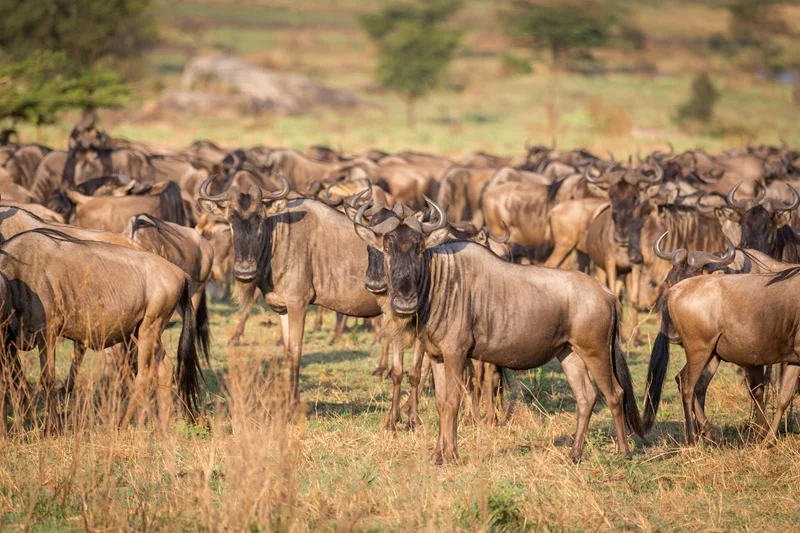
The herds reach the Western Corridor and meet the Grumeti River, where Nile crocodiles wait in the pools. Grumeti crossings are smaller and less predictable than the Mara ones, and they happen over a shorter window.
We do not have a camp in the Western Corridor, so we will not pretend it is our strength. Mawe Tented Camp is the closest of our properties, and Gnu Mara River Camp in the north is open from 1 June for guests arriving as the herds push toward the Mara.
By late July the front of the migration is usually at Kogatende in the north. Our guide to the migration in July covers that month on its own.
Dense wildebeest herd standing shoulder to shoulder on the Serengeti grassland

August to October: the Mara River crossings

This is the section of the year people plan whole trips around. The herds mass on the southern bank of the Mara River, wait, and cross in bursts that last anywhere from ten minutes to most of an afternoon.
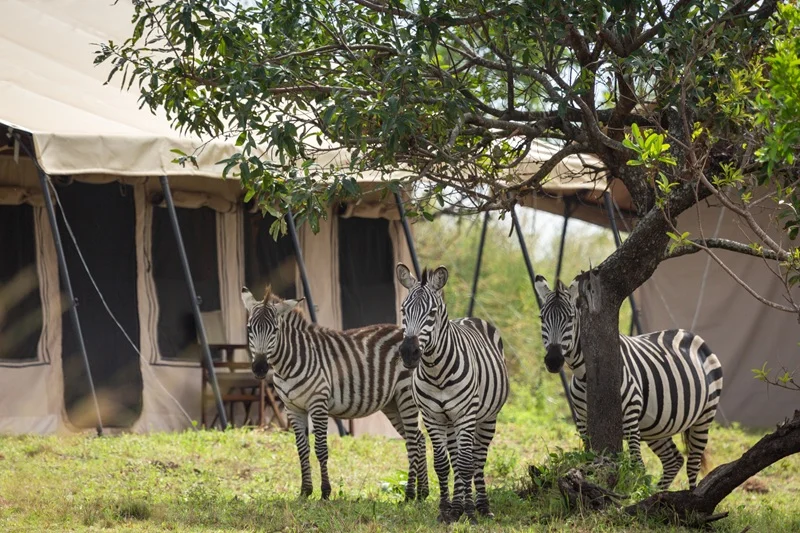
Gnu Mara River Camp is at Kogatende, 40 to 45 minutes from the river, with 10 tents, from $262 per person. It is open 1 June to 15 November. Nights are cold here in the crossing season, so the team puts hot water bottles in the beds each evening before guests turn in, and zebra graze between the tents most mornings.
Fewer vehicles reach this corner of the park than reach Seronera, which matters at a crossing, because a river bank crowded with vehicles is a worse place to watch from.
November and December

November and December: the herds turn south

The short rains bring the herds back down through the eastern Serengeti in November and December. They pass Soit Le Motonyi on the way, which means Mawe Tented Camp sees the migration twice a year rather than once, in November and January going south and again in April and May going north.
Gnu Mara River Camp closes on 15 November. Gnu Ndutu Camp is open again from late December, once the herds are back on the calving grounds.
December splits in two. The first three weeks are the tail of the southbound move through the east, and the last week is the start of the calving season at Ndutu.

The full year

Month
Where the herds are
Which of our camps is nearest
Open?
January
Ndutu, calving
Gnu Ndutu Camp
Open
February
Ndutu, peak calving
Gnu Ndutu Camp
Open
March
Ndutu, calving ends
Gnu Ndutu Camp
Open until 31 March
April
Central Serengeti, moving north
Mawe Tented Camp
Open
May
Central and western Serengeti
Mawe Tented Camp
Open
June
Western Corridor, Grumeti
Mawe Tented Camp
Open
July
Moving north toward the Mara
Gnu Mara River Camp
Open
August
Mara River, crossings
Gnu Mara River Camp
Open
September
Mara River, crossings
Gnu Mara River Camp
Open
October
Northern Serengeti, crossings continue
Gnu Mara River Camp
Open
November
Turning south through the east
Mawe Tented Camp
Open
December
Eastern and southern Serengeti
Mawe Tented Camp, then Gnu Ndutu
Both open late December
Crossings

Will you see a river crossing?

Nobody can promise you one. The herds gather on the bank and wait, sometimes for hours and sometimes for several days, and they cross when something starts them. What you can control is how close your bed is to the river, because that decides whether you can be there early and stay late.
A crossing day usually looks like this. You leave camp before first light, find where the herds have massed, and park. Then you wait. The animals move toward the water and turn back more than once before any of them commits, and some days none of them does.
That is why the 40 to 45 minute drive from Gnu Mara River Camp to the river is the number that matters most in August and September. A camp two or three hours out means arriving after the morning window has closed.
If a crossing is the whole reason for your trip, give yourself three nights at Kogatende rather than two. We would rather tell you that now than have you arrive with one morning and a lot of hope.
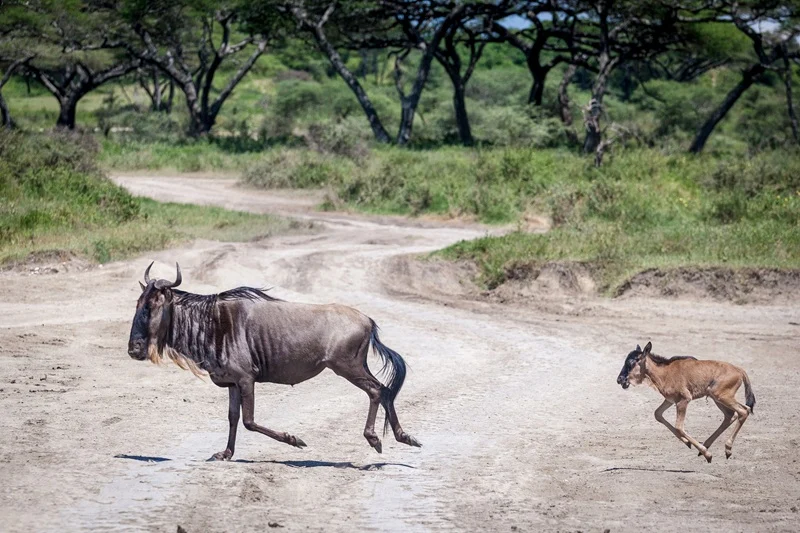
Wildebeest and its calf running across a safari track at Ndutu
The East

What to do when the herds are somewhere else

Book the east. Soit Le Motonyi in the central and eastern Serengeti has resident lions, leopards and cheetahs in every month of the year, so a stay there does not depend on where the migration has got to. The area was closed to visitors for 20 years for cheetah research, and it now has probably the highest cheetah density in the Serengeti.
One of the lions here had a name. Bob Jr, also called Snyggve, was a male with a dark mane who held territory around Mawe Tented Camp and could be heard roaring from the tents at night. On the morning of 10 March 2023 a new coalition of males challenged him near the Sametu Kopjes. He fought them and lost. The resident guide at Mawe Tented Camp was the only person there when it happened, out with photographers that morning.
You can read more about Soit Le Motonyi and why the big cats concentrate there.
Where to Stay

Where to stay for the migration

We own and operate three camps inside the Serengeti ecosystem, 10 tents each, and between them they cover the migration calendar.
Camp
Where
Open
Distance to the herds
From
Ndutu, Ngorongoro Conservation Area
Late December to 31 March
On the calving plains
$262 pp
Soit Le Motonyi, central and eastern Serengeti
All year
Herds pass November to January and April to May
$182 pp
Kogatende, northern Serengeti
1 June to 15 November
40 to 45 minutes from the Mara River
$262 pp
Two of the three come down out of season, and we would rather tell you that than have you plan around a camp that is not there. Gnu Ndutu Camp is a mobile camp, so it moves with the herds inside the Ndutu area rather than staying on one spot all season.
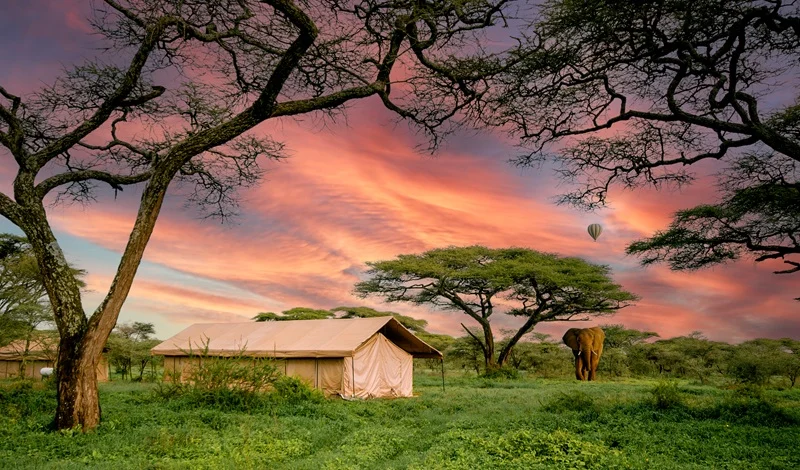
Gnu Ndutu Camp Outdoor View
Gnu Ndutu Camp
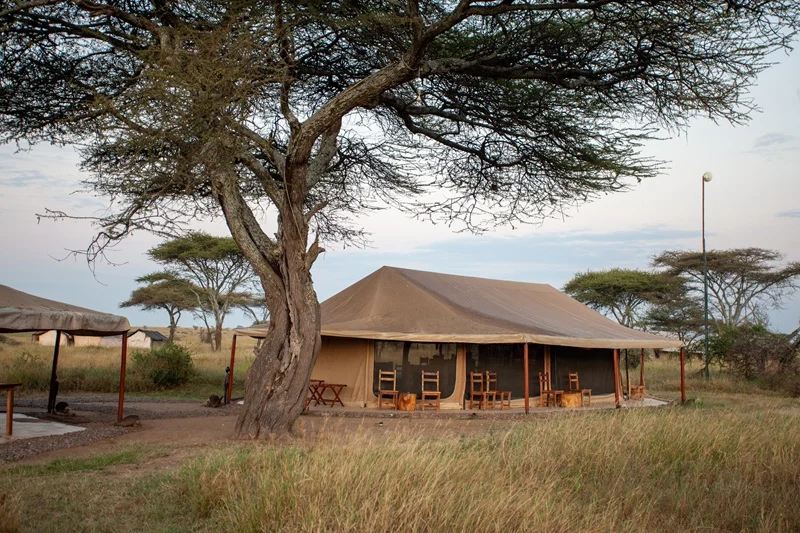
Mawe Tented Camp Outdoor
Zebras Standing Next to Gnu Mara River Camp
Gnu Mara River Camp
The Circuit

Building the rest of the route

The migration is one part of a northern circuit trip, and most guests pair it with two or three areas that do not move.
Tarangire has the elephant herds along the Lake Burunge corridor and it allows night game drives, which the Serengeti does not. The Ngorongoro Crater holds a resident population dense enough to cover in a single day, and it is a 30 minute drive from our Karatu Tented Lodge, which is our cheapest property at $101 per person.
The practical reason to add these is timing. Ndutu and Ngorongoro are next to each other, so a February calving trip absorbs the crater with almost no extra driving. An August trip to Kogatende does not, because the north is at the far end of the park, so plan the crater at the start or the end of that route rather than the middle.
You can see all five of our camps and lodges if you are building a longer route.
Costs

How much does it cost to see the Great Migration?

Accommodation starts at $182 per person per night at Mawe Tented Camp, and $262 per person per night at Gnu Ndutu Camp and Gnu Mara River Camp in the calving and crossing seasons. Park fees are charged separately, at roughly $75 to $85 per person per 24 hours including VAT. We book direct, so those are the real rates.
Included in the rate
Charged separately
The tent, en suite, on a full board basis
Park and conservation area fees
VAT and government levies
International and domestic flights
Guided game drives with our own guides and vehicles
Balloon flights and other add-ons
Transfers between our own camps
Visas, travel insurance, tips
Park fees work differently in the Ngorongoro Conservation Area and in Serengeti National Park, which matters if your trip covers Ndutu and the north in one route. We set out how park fees are paid in Tanzania in full.
Live rates and open dates are on our availability calendar.
Trip Length

How many days you need

Four nights is a realistic minimum for a migration trip, and six or seven is better. The Serengeti covers 14,763 square kilometers (5,700 square miles), and a two-night stay spends most of its daylight on transfers.
The split that works best pairs one migration region with one resident-wildlife region. In February that means Ndutu and the central Serengeti. In August it means Kogatende and the central Serengeti. You get the herds and a second area that does not depend on them.
Most guests fly into Kilimanjaro International Airport and connect by light aircraft to an airstrip near camp. The road from Arusha to Kogatende crosses the Ngorongoro highlands and central Serengeti and takes up to 12 hours, so it works better as a one-way leg than as a return.
Our 7 day Tanzania safari itinerary shows one version of the route with costs.
Questions

Frequently asked questions

February and August are the two strongest months. February gives you calving at Ndutu, with about 8,000 calves born a day at the peak and predators concentrated on the same plains. August gives you the Mara River crossings in the north. Choose between them on what you want to watch, not on which is better.

The herds spend most of the year in Tanzania and a few months in Kenya’s Maasai Mara. Tanzania has the calving grounds, the Grumeti crossings and the southern bank of the Mara River. Kenya has the northern bank from roughly August. We compare the two countries in Tanzania vs Kenya for a safari.

It depends on the month. Ndutu from late December to March, the central and western Serengeti in April and May, the Grumeti in June and July, and Kogatende on the Mara River from August to October. No single place holds the herds all year, which is why fixed lodges struggle with this.

Yes, somewhere in the ecosystem. The herds never stop moving and never leave the Serengeti system entirely. What changes is which part of Tanzania they are in, and April and May are the hardest months because the animals spread out into scattered groups rather than one mass.

About 1.5 million migratory wildebeest, from a survey carried out in March 2023 and published in April 2024. Roughly 260,000 zebra and several hundred thousand gazelle travel with them, which is where the 2 million figure quoted elsewhere comes from. We explain how the count is done.

Ndutu is inside the Ngorongoro Conservation Area, on the boundary with Serengeti National Park. The plains look continuous from a vehicle, but the two areas are managed by different authorities and charged separately, so it affects your permits and your fees.

For August and September at Kogatende, book eight to twelve months out, because camps in the north are small and the crossing season is short. February at Ndutu needs six months. April, May and November are usually available much later and cost less.

Tanzania · Northern Circuit

Book your stay with Mawe Lodges

Our own lodges and camps, our own guides, our own 4×4 vehicles. One team from arrival to departure.

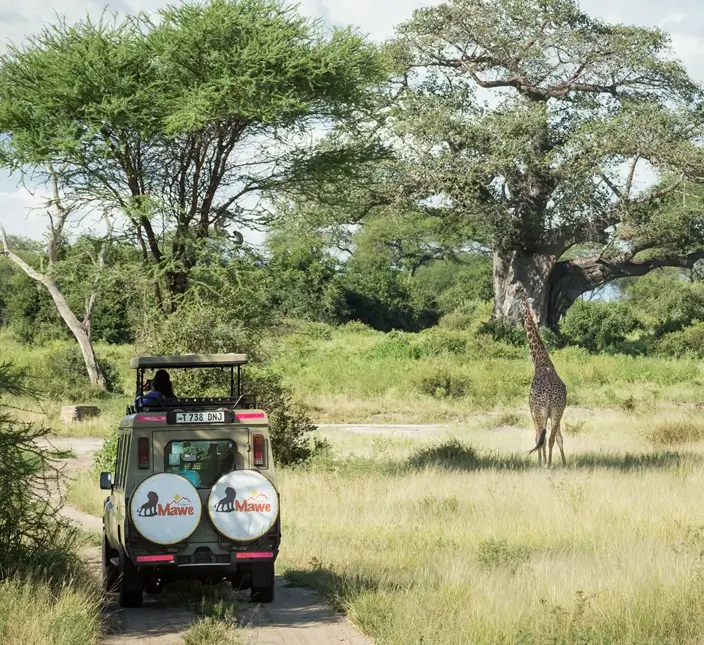
A Mawe Lodges safari vehicle on a game drive in Tarangire National Park