For tipping in Tanzania, Mawe’s published safari guidance suggests $20 to $25 per vehicle per day for your driver-guide and $10 to $15 per guest per day for camp staff. Those amounts use different units. The guide amount covers the vehicle’s booking party; the staff amount applies to each guest.
Treat the figures as a planning guide for voluntary gratuities. They are not a compulsory park charge or an extra accommodation fee. The amount you choose should reflect your budget, the service and any arrangements already stated in your booking.
Tipping in Tanzania at a glance
| Recipient | Mawe’s published suggested amount | Unit |
|---|---|---|
| Safari driver-guide | $20 to $25 | Per vehicle per day, shared by the booking party |
| Camp staff | $10 to $15 | Per guest per day, usually through the communal box |
The figures already appear in our Tanzania safari cost guide and honeymoon safari information. The calculations below separate the units so you can build a budget without counting the guide several times.
Keep tips separate from the confirmed package price. Park charges, transfers and optional activities have their own agreed costs. A gratuity does not replace payment for a service you have booked, and a paid service should not later be presented as a tip.
How much to tip your safari driver-guide
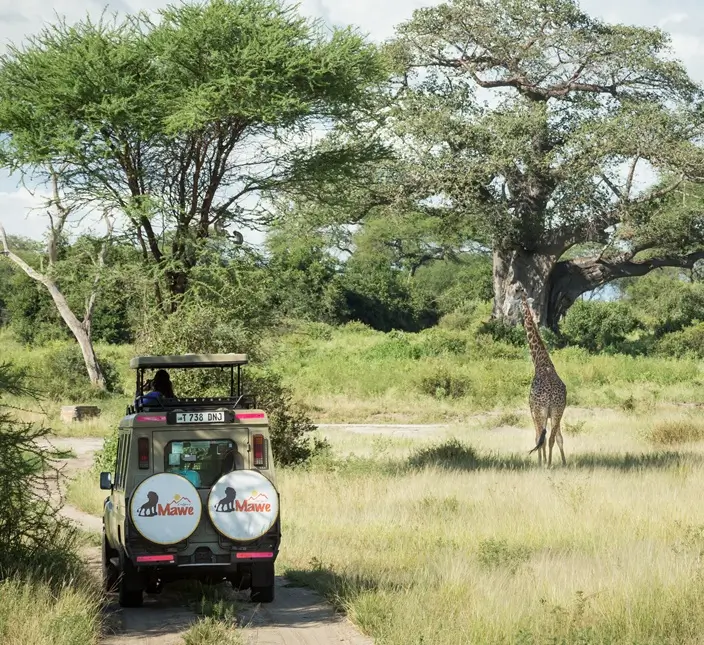
For a private booking, start with $20 to $25 for the vehicle for each guiding day. Divide that total between the guests who are contributing. Two guests do not each need to multiply the whole vehicle amount by the trip length.
For example, four adults sharing one guide and vehicle can budget $20 to $25 between them for a day. Divided equally, that is $5 to $6.25 each. They may choose a different amount, but the unit remains the vehicle rather than each seat.
The guide’s work includes more than finding an animal for a photograph. Driving, explaining the park, managing the route and helping with changes all form part of the service. A day without a rare sighting does not automatically mean the guide has given poor service.
If your booking uses more than one guide or vehicle, calculate each arrangement separately. A vehicle change halfway through the trip can mean you thank one guide before the next part starts. It does not mean you owe both guides the full-trip amount.
On a shared departure, ask how the operator expresses its suggested amount. A per-person guideline on another tour is not directly comparable with Mawe’s per-vehicle suggestion. Our private safari page explains the booking-party vehicle arrangement.
How much to tip camp staff
Mawe’s published suggestion for camp staff is $10 to $15 per guest per day. A communal tip box lets you recognize the team beyond the people you meet most often, including kitchen, housekeeping and other staff.
Two contributing guests can therefore allow $20 to $30 between them for a day of camp service. Four contributing guests can allow $40 to $60. That calculation is separate from the vehicle tip.
When you move between camps, give the staff gratuity for the time at each property. It should not all go to the final camp because that happens to be where the safari ends. Keep a short record of the stays if it helps you divide the cash.
For a stay measured in nights, clarify how the camp suggests counting arrival and departure days. Do not automatically count both as full extra days on top of every night. The examples below use explicitly stated staff-service days so the calculation remains clear.
The camp collection includes both year-round and seasonal properties. Moving to a different Mawe camp means a different team looks after your stay, even if one guide stays with your party throughout.
Two worked safari tipping budgets
These examples show arithmetic, not a new mandatory amount or an all-inclusive trip price. Both assume the group chooses the published suggested range. Change the number of guiding days and staff-service days to match your trip.
Two guests, seven guide days and seven staff-service days
| Part of the budget | Calculation | Total for both guests |
|---|---|---|
| Driver-guide | 7 days multiplied by $20 to $25 per vehicle | $140 to $175 |
| Camp staff | 2 guests multiplied by 7 days multiplied by $10 to $15 | $140 to $210 |
| Combined illustration | Guide plus camp staff | $280 to $385 |
If both guests contribute equally, that is $140 to $192.50 each. The example does not assume a particular seven-day itinerary has seven hotel nights. It states seven guide days and seven staff-service days as separate inputs.
If you have fewer camp-service days, reduce that part of the calculation. If a guide only looks after you for part of the trip, apply the guide amount to that part rather than the whole holiday.
Four guests, three guide days and three staff-service days
| Part of the budget | Calculation | Total for all four guests |
|---|---|---|
| Driver-guide | 3 days multiplied by $20 to $25 per vehicle | $60 to $75 |
| Camp staff | 4 guests multiplied by 3 days multiplied by $10 to $15 | $120 to $180 |
| Combined illustration | Guide plus camp staff | $180 to $255 |
Divided equally, that is $45 to $63.75 per guest. Adding more guests to the same vehicle spreads the guide contribution. It does not reduce a per-guest camp-staff suggestion in the same way.
These budgets exclude tips for separately booked local guides or other independent services. They also exclude purchases, drinks and activities. Add those to your travel budget only where you plan to use them.
Who receives the tip
Your safari driver-guide and the camp team are separate recipients. If you use the communal camp box, you do not also need to tip every staff member individually to follow the suggestion above.
You can choose to recognize an individual for additional help. That remains your decision and should not create pressure to repeat the same tip for each person you meet. Ask the camp manager how the communal system works if you want to understand the distribution.
A short transfer driver or independent local guide may have a different role from your safari driver-guide. Before adding another full-day vehicle tip, check whether the person is already part of the service you have budgeted for. The same principle applies to a guide who joins a particular walk or visit.
For an arranged community visit, agree the visit fee and any separate guiding payment first. The cultural interaction information provides the context. A voluntary tip should not replace an agreed payment to hosts or a local guide.
Cash, currency and changing money
Ask which currency the recipient prefers. Dollars may be convenient for a budget expressed in dollars, while Tanzanian shillings can be practical for smaller local payments. Agree an equivalent if you are working in a different currency rather than assuming the numbers are interchangeable.
Bring manageable denominations so you can divide the budget between camps and the guide. A large note can be difficult to use if the recipient cannot make change. Do not depend on a camp or airstrip having cash available.
Keep gratuity money securely with the rest of your travel cash. A labeled envelope for each camp can help you separate the amounts without displaying the whole budget. Carry only what you need for the day in your easily accessible bag.
Do not assume you can add a gratuity to a card payment at departure. Ask the reservations team before traveling if cash access is difficult for you. A facility that accepts cards for room charges may use a different process for staff tips.
When and how to give a tip
The end of the guiding service is a practical time to thank your driver-guide. If the same guide remains with you for the whole safari, one gratuity at the end can avoid repeated daily calculations.
For camp staff, departure from each camp is a useful point to use the communal box or the arrangement the manager explains. If you leave early, organize this the previous evening instead of interrupting the departure transfer.
You can include a short note if you want to thank the team for something specific. A tip does not need a public presentation. Keep the choice discreet and avoid comparing amounts in front of staff or other guests.
Our game-drive information explains the activity itself. Gratuities remain a separate consideration from the meals, guiding and vehicle services listed in a safari proposal.
Children, groups and shared vehicles
A family’s tipping budget needs a conversation about the adults contributing and the service received. Do not automatically multiply an adult suggestion by every child without checking how the camp advises families to apply it.
For several couples traveling together, agree how you will split the vehicle tip before the final day. A shared envelope can avoid one couple paying the full amount while another assumes it has already contributed. Each party can still make its own decision about what to give.
If your group separates into two vehicles, the calculation changes. There are now two driver-guide services rather than one shared vehicle. The written itinerary should make that arrangement clear before you build the tipping budget.
Use the actual days and stays in your proposal. The existing 7-day Tanzania safari is one itinerary example, but a different route may use another number of camps and guiding days.
If service falls short or the bill has a service charge
Raise a problem while the team can still respond to it. A room, meal or guiding concern may have a practical solution during the stay. You do not have to wait until departure and communicate the issue only through the gratuity amount.
If the bill includes a service charge, ask what it covers and whether staff receive it. A service charge, tax and discretionary tip are different labels. Do not assume that one replaces another without an explanation.
If your available budget is below the suggested range, the gratuity remains your choice. No wildlife sighting or additional service should be conditional on promising a larger tip. Clear feedback and a clear booking agreement matter throughout the trip.
Tipping questions
Is tipping compulsory in Tanzania?
The amounts in this safari guide are voluntary gratuity suggestions, not compulsory Mawe accommodation or park charges. Your written booking terms identify the services and charges you agree to pay. Tips remain a separate decision based on the service and your budget.
Is the driver-guide amount per guest?
Mawe’s published $20 to $25 suggestion is per vehicle per day. The contributing guests can divide it between them. A per-person tip suggested by another operator uses a different basis, so compare the unit before comparing the number.
Do we need to tip the guide every day?
You can budget by day and give the total when that guide’s service ends. If the guide changes, separate the days for each person. Confirm any special arrangement with the reservations team before departure.
Can I use a credit card for tips?
Only if the property confirms a suitable process. Card acceptance for a room bill does not guarantee that the same payment method reaches the staff tip pool. Cash planning before the trip avoids relying on an unconfirmed facility.
What if we cannot work out the total?
Use two lines: guide days multiplied by the vehicle suggestion, then contributing guests multiplied by staff-service days and the staff suggestion. Keep additional local services separate. Our trip-planning page connects the rest of the preparation with your confirmed itinerary.
The published suggested ranges remain $20 to $25 per vehicle per guide day and $10 to $15 per guest per camp-staff day.
Plan your safari with Mawe Lodges
Send us your dates, guest numbers and the camps or parks you want to visit. Our team can explain the arrangements and prepare a quote.