The Tanzania safari cost for two people sharing a room and a vehicle runs $250 to $400 per person per day at the budget end, $400 to $600 in the mid range, $600 to $900 for luxury, and $900 upwards once you are flying between camps. Park fees are inside those figures.
Over seven days that is about $1,750 for a camping trip and $4,200 to $6,300 for a luxury one, before international flights.
The figure that matters to you depends on four things: the season you travel in, how many of you share the vehicle, whether you sleep inside the parks or outside them, and what a given quote actually includes. So the rest of this page takes each of those apart.
What follows breaks the Tanzania safari cost into the parts it is actually made of: what the government takes in conservation fees, what the season does to your bill, and which line items you pay separately no matter who you book with.
We can be specific about this because we are not writing about someone else’s business. We own our camps, we employ our guides and we run our own 4×4 Land Cruisers. Every figure below is either a published government fee or a number off our own rate card, which means we can show you where each dollar goes instead of quoting a range we read somewhere.
How much does a Tanzania safari cost?
For a mid-range trip with a private vehicle, a professional guide, a permanent tented camp and all park fees covered, budget $400 to $600 per person per day. Below that you are camping or sleeping outside the park boundaries. Above it you are paying for smaller camps, better positions inside the parks, and flights instead of long drives.
All figures below are per person, two people sharing a room and a vehicle, and include park fees.
| Safari style | Per person per day | 7 days, per person |
|---|---|---|
| Budget camping | $250 to $400 | $1,750 to $2,800 |
| Mid-range tented camps | $400 to $600 | $2,800 to $4,200 |
| Luxury small camps | $600 to $900 | $4,360 to $6,300 |
| Luxury fly-in | $900 to $2,000+ | $6,300 to $14,000+ |
These figures assume two people sharing. A solo traveller pays more per person, because the vehicle, the guide, the fuel and the crater fee cost the same whether one person or six are in the car. Solo rates are quoted trip by trip rather than off a table.
What is the average cost of a safari in Tanzania?
Across the enquiries we see, the average lands close to $600 per person per day, or around $4,200 for a week. The average safari cost Tanzania visitors actually pay tends to sit higher once international flights, tips and a balloon ride are added, which is why the total on your credit card rarely matches the quote you approved.
Still, treat any single average with suspicion. A seven-day trip in March and the same seven days in August are different products at different prices, and averaging them produces a number that describes neither.
Tanzania safari cost per day
Daily pricing is how the industry actually works. Operators build a quote by adding up what each day costs, then present you with a total. In short, understanding the daily rate is the fastest way to tell whether a quote is fair.
A day on safari has four fixed components before anyone makes a profit:
- Conservation fees, paid to the government per person per day
- Accommodation, per person per night
- Vehicle, fuel and guide, per vehicle per day
- Food and water, usually bundled into the accommodation
Here is a real Serengeti day in high season, using our own published rates. To begin with, the government portion is $82.60 per adult. A tent with full board in one of our Serengeti camps is $280 per person. A full day of game driving with a private Land Cruiser, guide and fuel is $300, which is $150 each for two people sharing.
That is $512.60 per person for one day, and none of it is margin, marketing or profit. In other words, it is the floor.
That is why quotes under $300 a day almost always involve sleeping outside the parks, sharing a vehicle with strangers, or both.
Safari in Tanzania cost per person
Three numbers get confused constantly, and the confusion costs people money.
Per person per day is the daily rate for one traveller. Per person total is that rate multiplied by the number of days. Total trip cost is what you pay for everyone travelling together, which is the number most quotes lead with because it looks like a package price.
A quote of $6,000 might be $3,000 each for two people over five days, which is $600 per person per day. Or it might be $6,000 each. Ask which one you are looking at before you compare it to anything.
Group size moves the per-person figure more than almost any other factor. A vehicle costs the same to run whether one person or six are sitting in it, so the safari in Tanzania cost per person drops as you fill seats. For example, on our own nine-day itinerary, four people pay 20 percent less each than two, and six pay 27 percent less.
What the daily rate includes, and what it does not
A quoted daily rate on the northern circuit normally covers your accommodation, all meals, drinking water, the vehicle, fuel, your guide, and every conservation and camping fee for the parks on your itinerary. If a quote excludes park fees, it is not a lower price, it is an incomplete one. Indeed, conservation fees are the single largest fixed cost on any Tanzanian itinerary and they are non-negotiable.
What it usually does not cover: international flights, visas, travel insurance, tips, alcohol and soft drinks, laundry, and optional activities such as balloon flights or night drives. Some camps include laundry and house drinks, which is worth checking when comparing two quotes that look identical on paper.
Meals, too, are almost always included, and the standard is higher than most people expect. Food on safari is prepared fresh in camp, including in remote locations where everything arrives by road.
Comparing quotes
Why a room rate and a safari rate are not comparable
A camp publishes a nightly room rate. A safari is quoted as a daily rate. At first glance the two look comparable and are not.
A nightly camp rate covers your tent and your meals. A daily safari rate covers all of that plus your vehicle, guide, fuel, park fees and the operator’s margin. As a result, the second number is roughly double the first for the same standard of camp.
Our own camps publish full board rates from $118 to $286 per person per night, with park fees collected separately by the park authority. Put $286 against a camp quoting $1,700 per night and it looks like a different class of product. It is not. In truth, one figure is a bed and three meals, the other is a whole day of safari.
Always check whether fees, vehicle and guide sit inside or outside a price before you compare it to anything. Almost every argument about Tanzania safari cost comes down to two people comparing numbers that measure different things.
Budget safari Tanzania cost
The budget safari Tanzania cost sits between $250 and $400 per person per day, and the savings come from three specific compromises.
You sleep in a dome tent on a public campsite rather than in a permanent camp. You share a vehicle with other travellers, usually six or seven people in a minibus or converted Land Cruiser. Finally, you stay outside the park gates where possible, in Karatu or Mto wa Mbu, driving in each morning and losing an hour of game viewing at each end of the day.
Public campsite fees are $30 per adult per night in the national parks and $35.40 in the Ngorongoro Conservation Area, against $250 or more for a permanent camp. Overall, that single line is where most of the difference comes from.
What does not change is the conservation fee. A budget traveller in the Serengeti pays exactly the same $82.60 per day as someone in a luxury camp, which is why the gap between budget and mid-range is narrower than people expect. Once fees are covered, the marginal cost of a better bed is smaller than the marginal cost of entering the park at all.
The honest trade-off is time and comfort rather than wildlife. After all, the animals do not know what you paid. But a camp inside the park puts you at the good sightings at dawn, while a lodge in Karatu puts you an hour behind them.
Mid-range Tanzania safari cost
At $400 to $600 per person per day you move from a dome tent to a permanent room with a proper bed and an en-suite bathroom, and from a shared minibus to a private vehicle.
Generally, the properties in this band are large. A forty to eighty room lodge can fill its beds at that rate because volume does the work, which is the trade you are making: a comfortable room and a private vehicle, at an address that a hundred other guests are also leaving from each morning.
A private vehicle is the upgrade that changes the trip most. You decide when to leave, how long to sit with a leopard, and when to go back for lunch. By comparison, shared vehicles run to a group timetable and the group usually wants different things.
Mid-range is also where the season starts to bite. Across our own rate cards the same room is 18 to 30 percent cheaper in the low season than at peak, depending on the property.
How much does a luxury Tanzania safari cost?
Luxury starts at about $600 per person per day and runs to roughly $900 before you start flying between camps. Above $900 you are paying for aircraft rather than for a better tent.
Our own itineraries start at $623 per person per day for two people sharing, which is where that band begins.
What that money buys is not marble bathrooms. Rather, it buys position and density. All five of our properties have ten tents or cottages. In contrast, the large Serengeti lodges run thirty to seventy-five rooms. At a sighting that is the difference between three vehicles and twenty, and it is the single thing a guest notices most.
Position does the rest of the work. Mawe Tented Camp sits in the Soit Le Motonyi area of the central-eastern plains rather than in Seronera traffic. Baobab Tented Camp is inside Tarangire on the Lake Burunge corridor rather than outside the gate. Gnu Ndutu Camp opens on the southern plains from late December to March for the calving, then closes when the herds move on. None of those addresses costs you a flight to reach.
What luxury actually costs, using published numbers
Central Serengeti, peak season, per person per night, like for like.
| Ours | A named luxury camp nearby | |
|---|---|---|
| Room and full board | $280 | |
| Conservation fees | $82.60 | |
| Private vehicle, guide and fuel | $150 | |
| All in | $512.60 | $1,700 |
Both figures are published. Theirs includes selected drinks and an airstrip transfer that our guests do not need, because they arrive in the same vehicle they have had all week. Allow for that and the gap is still close to three times.
Ultimately, the difference is not the tent. It is that we own the camps, employ the guides and run the vehicles ourselves, so nobody is hiring us a vehicle or subcontracting our guiding. Fewer businesses have to be paid before the kettle goes on, and that shows up in the rate rather than in the room.
Tanzania luxury safari cost per day
The Tanzania luxury safari cost per day breaks down as follows on the northern circuit. The first three lines are published rates rather than estimates.
| Component | Per person per day |
|---|---|
| Ten-tent camp, full board | $195 to $286 |
| Conservation fees, Serengeti high season | $82.60 |
| Private vehicle, guide and fuel, two sharing | $150 |
| Concession and camping fees | $60 to $100 |
| Transfers, water, operator margin | $110 to $270 |
That lands between $600 and $900, and it is the arithmetic behind every luxury quote you will be shown. Anything quoted well above it is either a fly-in itinerary or a package carrying costs beyond the safari.
Gnu Mara River Camp is the clearest example of paying for position rather than for fittings. It publishes $286 per person per night, full board, and it sits forty-five minutes from the Mara crossing points during the Great Migration. In those months that address is the entire product.
Luxury safari Tanzania and Zanzibar cost
A luxury safari Tanzania and Zanzibar cost for two weeks, split roughly eight days on the northern circuit and six on the coast, comes to $7,500 to $13,000 per person. The safari carries most of that. Zanzibar is cheaper per night than a Serengeti camp because there are no conservation fees and no vehicle to run.
Specifically, beach hotels run $150 to $350 per person per night at the mid range and $350 to $600 at the top. Add the domestic flight, about $250 to $400 per person one way from Arusha or the Serengeti, which beats the two-day drive and ferry by a wide margin.
Zanzibar pairs with the northern circuit directly. You do not need to climb Kilimanjaro first, which is how several guides present it, and the usual shape is eight days on safari then five or six on the coast. Safari first, coast second. Nobody wants to leave the beach at 5am for a game drive.
One thing worth saying plainly: our own camps are on the northern circuit and we do not own a property in Zanzibar. Beach nights are booked with hotels we have inspected and appear on your invoice at what they charge us.
Self drive safari Tanzania cost
Self drive looks like the obvious saving and rarely is. The realistic self drive safari Tanzania cost is $250 to $400 per person per day for two people, which is budget-tour money for considerably more work.
| Line item | Cost |
|---|---|
| 4×4 with rooftop tent, hire | $150 to $250 per day |
| Fuel | $60 to $100 per day |
| Conservation fees, per adult | $53.10 to $82.60 per day |
| Foreign-registered vehicle permit, NCAA | $47.20 per day |
| Public campsite, per adult | $30 to $35.40 per night |
Regardless, the fees do not move. You pay the same conservation charge as everyone else, plus a vehicle permit that guided guests never see on their bill because it is inside the operator’s rate.
What you give up is the guide, and on a first trip that is the whole product. Guides know which kopje the lions used yesterday and which river bend the leopard works. Without one, most self-drivers spend two days learning where to look. Add to that no reliable fuel inside the Serengeti, expensive recovery from a bogged vehicle in the wet months, and road distances longer than the map suggests. On balance, self drive suits return visitors who have done it guided once.
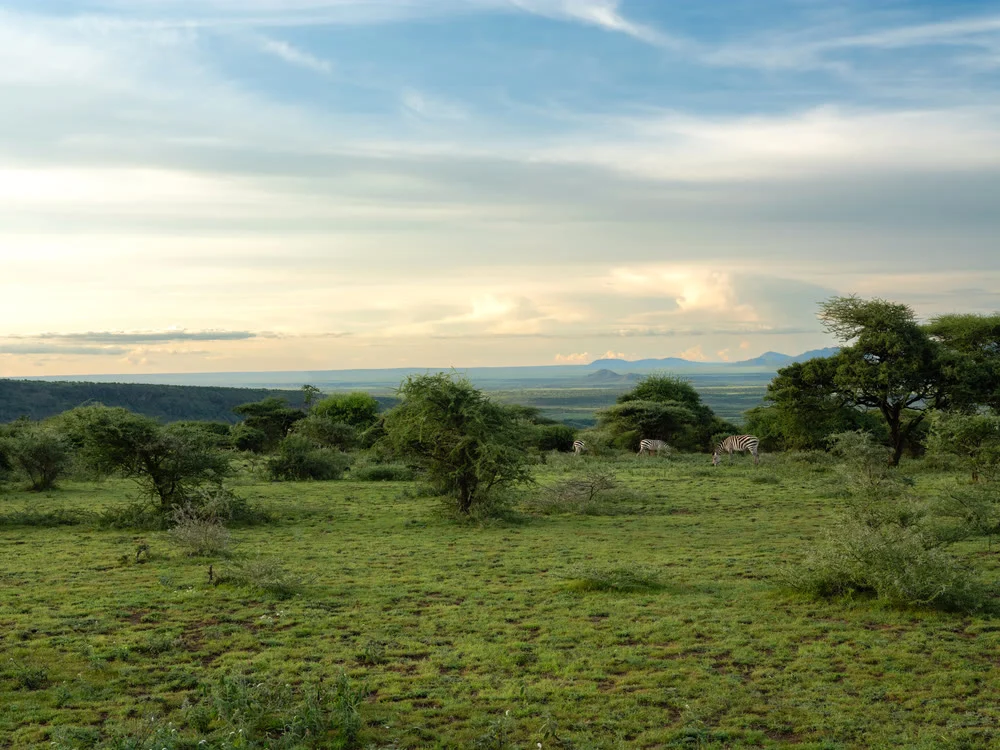
What makes your Tanzania safari cost go up or down
Park entry and conservation fees
Conservation fees are the largest fixed cost on any Tanzanian itinerary and the one people most often leave out of their budget, so here they are in full.
Tanzania National Parks publishes its official tariff for the 2023/24 financial year, valid to 30 June 2024, and has not published a newer schedule publicly since. Nevertheless, those rates remain what operators quote against. They are VAT exclusive, so 18 percent is added.
| Park | Non-resident adult, per day | With 18% VAT |
|---|---|---|
| Serengeti, high season | $70 | $82.60 |
| Serengeti, 15 March to 15 May | $60 | $70.80 |
| Kilimanjaro | $70 | $82.60 |
| Tarangire, high season | $50 | $59.00 |
| Tarangire, low season | $45 | $53.10 |
| Lake Manyara, high season | $50 | $59.00 |
The Ngorongoro Conservation Area is administered separately and publishes its tariffs VAT inclusive, which is a common source of confusion when people compare quotes.
| Ngorongoro item | Non-resident rate |
|---|---|
| Adult entry, 16 and over, per day | $70.80 |
| Child, 5 to 16, per day | $23.60 |
| Crater service fee, per vehicle per descent | $295.00 |
| Public campsite, adult | $35.40 |
The crater fee, and who pays less
That $295 crater fee is charged per vehicle, not per person, and it is a single 24-hour descent. Two people descending pay $147.50 each on top of entry. Six people in a vehicle pay $49.17 each. It is the clearest example on this page of why group size moves your bill.
Additionally, children under five enter free everywhere. Child rates apply from five to fifteen in the national parks and five to sixteen in Ngorongoro.
The same structure is what makes a Kilimanjaro climb expensive. At $82.60 per person per day over six to eight days the government takes $500 to $660 before anyone has carried a bag, which is why a well-run climb costs $2,500 to $4,500 per person and anything under $2,000 is usually paying porters badly.
A share of these fees funds anti-poaching and conservation work directly, which is worth remembering when the total looks steep. We publish our own carbon emission position separately.
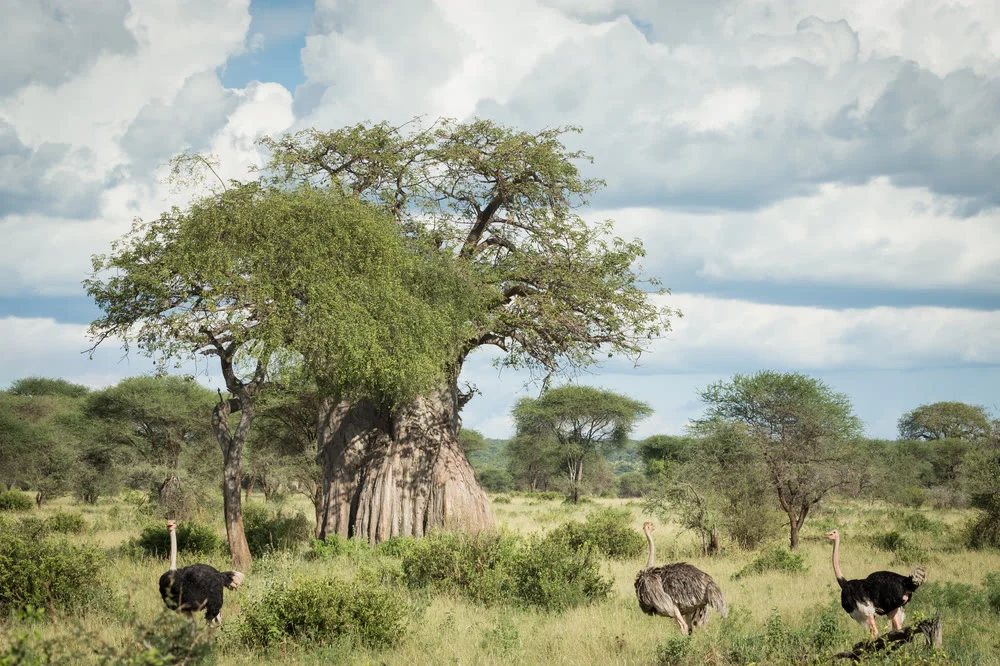
Season and time of year
Season is the single biggest lever you control. The Tanzania Meteorological Authority divides the north into a long rains period from March to May, a short rains period around November and December, and dry conditions from June to October.
Accordingly, camp rates follow that pattern closely. June to October is peak, and December through early January carries a separate festive surcharge, often with minimum-stay requirements. April and May are the cheapest months of the year, and some camps close entirely. Ours are a fair example of how seasonal this business is: Gnu Ndutu Camp runs late December to March for the calving, Gnu Mara River Camp runs June to mid November for the crossings, and Baobab Tented Camp and Karatu Tented Lodge stay open year round. Check a camp’s operating months before you fall in love with it.
Green season travel is genuinely good value if you accept the trade. The grass is high, some tracks become difficult, and the light for photography is better than at any other time of year. Our guide to the best time to visit Tanzania sets out the month-by-month picture, and the best time to visit Serengeti page covers how the herds move through the park across the year.
February is its own case. The wildebeest calving season on the southern plains draws high-season pricing in what is otherwise a shoulder month, because the predator action around Ndutu is the best of the year.
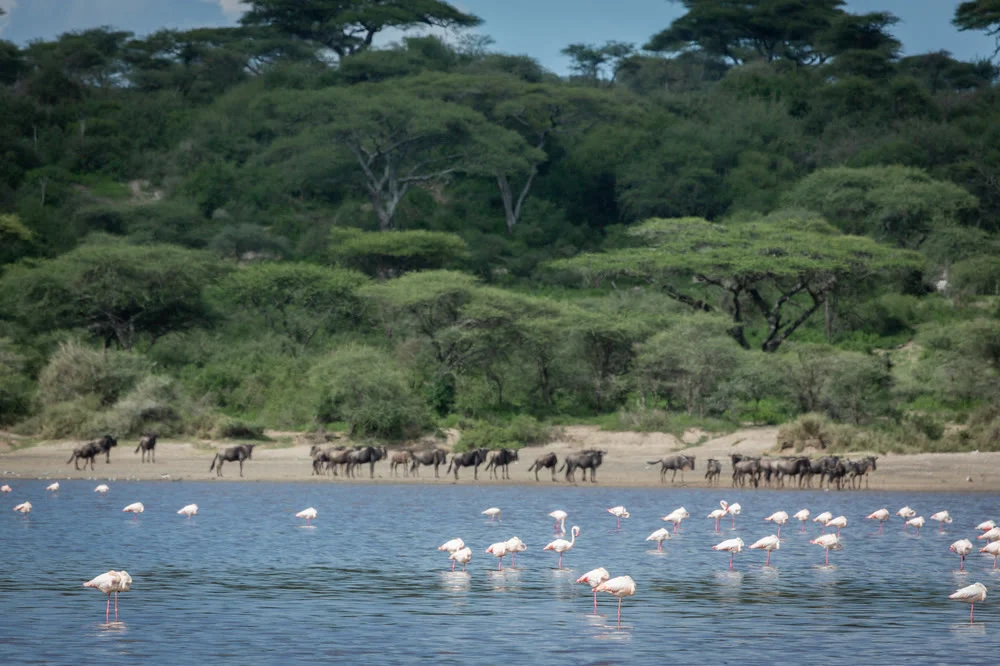
Group size
Vehicle, guide, fuel and the crater service fee are all per vehicle. Conversely, accommodation and conservation fees are per person. That split is why a group of four pays noticeably less each than a couple.
Our own nine-day itinerary shows the effect exactly, and the numbers are published rather than estimated:
| Travellers | Per person |
|---|---|
| 2 | $5,605 |
| 3 | $5,515 |
| 4 | $4,474 |
| 6 or more | $4,105 |
Two people to six cuts the per-person price by 27 percent for an identical trip. The step from three to four is the biggest single drop, because that is where a second row of seats stops being empty.
Driving safari vs fly-in safari
Driving is cheaper and shows you the country between the parks. Flying costs more and buys back a day or two of game viewing.
A one-way light aircraft hop within the northern circuit runs $250 to $400 per person. Against that, the Arusha to Serengeti drive is seven or eight hours. On a five-day trip, flying one leg can add a genuine extra day in the park.
However, for longer itineraries the calculation shifts. On ten days or more, the drives become part of the experience rather than an obstacle.
What the price actually includes
Two quotes for the same week can differ by thousands without either being wrong, and the reason is almost always what sits inside them.
Conservation fees are the usual culprit. At $82.60 per person per day in the Serengeti, a seven-day itinerary carries roughly $500 per person in government charges alone. A quote that leaves them out is not cheaper, it is incomplete, and you will pay them at the gate either way.
After that, check the vehicle. A private vehicle and a seat in a shared minibus are different products at a similar-looking price. Then check whether the crater descent, internal flights, drinks and tips are in or out. Ask for the exclusions list rather than the inclusions list, because that is the one that tells you what your final bill will be.
How long you go for
Per-day costs fall slightly on longer trips because fixed costs such as airport transfers and the Arusha overnight spread further. The bigger effect is that fewer days means a higher proportion of your time is spent driving between parks rather than in them.
Five days is the practical minimum for the northern circuit. Seven is comfortable. Ten, meanwhile, lets you reach the north of the Serengeti without rushing, which is where the river crossings happen.
Costs you pay on top of the safari price
These fall outside almost every Tanzania safari cost quote you will be sent, so budget them as a separate line rather than assuming they are covered.
Getting there
International flights
$800 to $1,800 return from Europe, $1,100 to $2,200 from North America, depending on season and how far ahead you book. Kilimanjaro International is the convenient arrival point for the northern circuit. Flying into Dar es Salaam is often cheaper but adds a domestic leg.
Paperwork
Visa, insurance and vaccinations
A single-entry tourist visa is $50 for most nationalities and $100 for US passport holders, applied for online in advance. Travel insurance with medical evacuation cover runs $80 to $250 and is not optional this far from a hospital. Yellow fever certification is required only if you arrive from a country where it is endemic.
Gratuities
Tipping on safari in Tanzania
Tipping is expected and it is a real line in your budget. Current guidance for the northern circuit:
- Driver-guide: $20 to $25 per vehicle per day
- Camp staff, into the communal box: $10 to $15 per guest per day
- Cook on a camping safari: $10 to $15 per vehicle per day
For two people over seven days that is roughly $250 to $400 in total. Bring it in cash, in small denominations, in notes issued after 2009.
Activities
Balloon safari, walking safari and night drives
A Serengeti balloon flight is $600 to $650 per person including the breakfast afterwards, and it books out months ahead in peak season. Walking safaris run $30 to $80 per person for a few hours where they are permitted.
Night drives are permitted in Tarangire and not in the Serengeti or the crater. A shared night game drive with us is $94.50 per person, and TANAPA charges a further $59 per person activity fee on top, so the real cost of seeing your first genet or civet is about $153.50 a head for two to three hours after sunset. It is the one activity where the government fee is almost as large as the activity itself.
Cultural visits to Maasai communities are typically $30 to $70 per person, and we would rather you booked those through the camp than at the roadside, so the money reaches the community.
How Tanzania safari cost compares with Kenya, Botswana and South Africa
Tanzania sits in the upper middle of the African market. It is more expensive than Kenya and South Africa, and considerably cheaper than Botswana or Rwanda.
| Country | Mid-range, per person per day |
|---|---|
| South Africa | $250 to $500 |
| Kenya | $350 to $600 |
| Tanzania | $400 to $700 |
| Zambia | $500 to $800 |
| Botswana | $800 to $1,500 |
Kenya’s lower price comes largely from lower park fees, and the driving distances are shorter. What Tanzania offers against that is scale: the Serengeti ecosystem is roughly six times the size of the Mara, and the herds spend most of the year on the Tanzanian side. South Africa is cheapest because of self-drive access and a competitive domestic market, and it has malaria-free reserves, which matters for families with young children.
Where to save
How to bring your Tanzania safari cost down without losing the wildlife
Six changes that save real money, in order of how much they save against how little they cost you:
- Check what each quote includes before you compare them. Two Tanzania safari cost quotes can differ by thousands purely on whether conservation fees and a private vehicle sit inside the number. Ask for the exclusions list first.
- Travel in the green season. On our own rate cards a low season night is 18 to 30 percent cheaper than the same room at peak, and the wildlife does not leave.
- Fill the vehicle. On our nine-day itinerary four people pay 20 percent less each than two, and six pay 27 percent less.
- Cut one park, add days elsewhere. Every boundary you cross is another day of conservation fees. Three parks in seven days costs more and shows you less than two.
- Skip the crater descent if budget is tight. $295 per vehicle plus entry for a single 24-hour window. Tarangire and Lake Manyara give more animal time per dollar.
- Mix tiers. A night inside the park where position matters, a highlands lodge either side. A highlands lodge runs $118 to $144 against $256 to $286 for a camp inside the parks, and carries no conservation fee for that night.
What we would not cut: the private vehicle, or the number of days. A rushed six-day trip across four parks costs more than a relaxed one across two, and shows you less.
Sample 9-day Tanzania safari cost breakdown
This is a published price rather than a worked example. Nine days across the northern circuit, two people sharing, private vehicle and guide throughout, staying in our own camps.
| Item | Per person |
|---|---|
| Nine-day itinerary, two sharing | $5,605 |
| Tips | $230 |
| Visa | $50 |
| Travel insurance | $150 |
| Drinks, laundry, souvenirs | $260 |
| Total on the ground, per person | $6,295 |
| International flights | $1,200 |
| Trip total, per person | $7,495 |
The itinerary line covers accommodation, all meals, the private vehicle, guide, fuel, and park and crater fees.
That works out at $623 per person per day for the safari itself, which is where the luxury band begins.
Four travellers on the identical trip pay $4,474 each, as the group size table above shows. Mawe Tented Camp and Karatu Tented Lodge are two of the properties on this route.