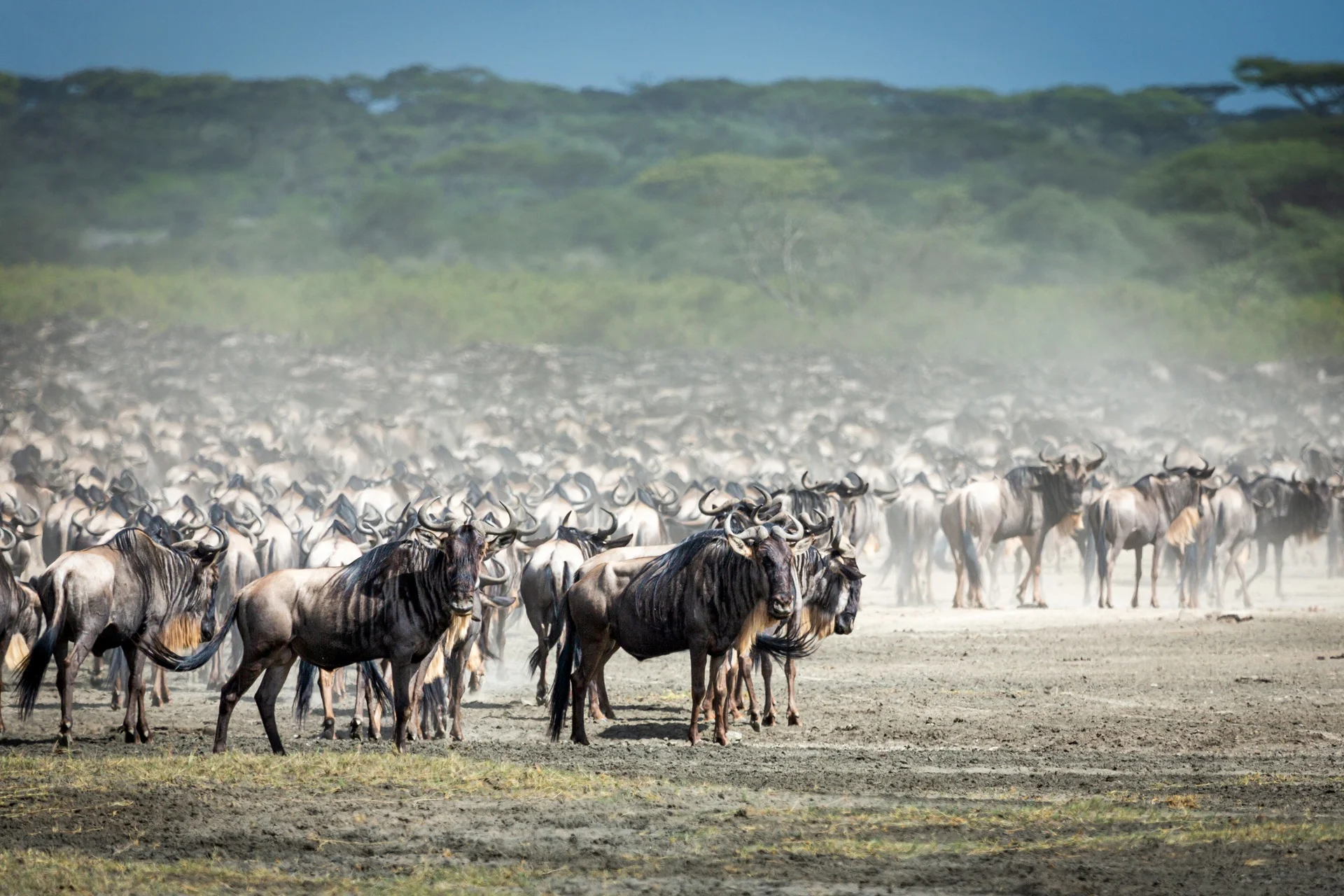
Tanzania in February is the one month of the calving season with nothing moving inside it. Our rates were set on 6 January and hold until the 28th. The Serengeti conservation fee does not move until 14 March. No camp of ours opens or closes. And the herds are on one piece of ground for all twenty-eight days.
That makes it a month you cannot book badly. A trip starting on the 3rd and a trip starting on the 24th cost the same and show you the same thing, which is not something you can say about many weeks on this circuit.
Four of our five properties are open. The fifth does not open until June.
Is February a good time to visit Tanzania?
Yes, for most people, and especially if you want the calving herds. February is the peak of the wildebeest calving season on the southern plains, and it is the driest of the three months that calving spans. You get the heaviest concentration of animals in the year, on ground firm enough to reach them.
Tanzania in February suits photographers for the same reason. The grass is low, the light is strong, and the animals are out in the open instead of tucked into thick cover.
There are people it does not suit. If you have come for a river crossing, February is the wrong month, and our camp in the north is closed until June. If you want Tarangire at its best, those elephant concentrations build from June, when the water everywhere else has gone.
The month nothing moves in
A date inside a month can change what a trip costs and what it shows you. Tanzania in February contains no such date, and that is worth more than it sounds.
| What happens in February | |
|---|---|
| Our camp rates | No change. The high season band covers 6 January to 28 February |
| Serengeti conservation fee | No change. The peak rate holds to 14 March |
| Ngorongoro fees | No change, in any month |
| Camps opening or closing | None. The next movement is 31 March |
| Where the herds are | The southern plains, for the whole month |
| Balloon launch sites | No change. Ndutu launches carry on to mid-March |
The practical use of that is simple. You can book the week that suits your work and your children’s school rather than the week that suits the calendar, and nobody comes home and discovers that a different fortnight would have been cheaper. February asks you no questions.
One date does matter, and it is the last one. Our high season ends on the 28th and low season begins the next morning, so the last week of February and the first week of March are the same safari at two different prices.
Going on safari in Tanzania in February
A Tanzania safari in February is built around open plains. In the dry season the animals come to you, because water is in a few known places. In February water is everywhere, so the animals spread out. On the southern plains that works in your favor, because you can see them from a long way off.
Days start early. You are out before the heat. The herds are already grazing and the predators are still working from the night.
We own our vehicles and our guides are on our payroll, so your day is not fixed to a fleet schedule. If the herds move overnight, your guide changes the route that morning. You can see how we set up a full day game drive and what it costs.
Where the herds are in February
On the southern short grass plains, across the Ndutu area and into the southern Serengeti. Ndutu is inside the Ngorongoro Conservation Area, not Serengeti National Park, which is why the fees and the driving rules there differ from the ones further north.
The herds stay for the grass. Short grass on the southern plains grows on volcanic ash soils, and it carries the calcium and phosphorus a nursing female needs, so the animals concentrate there instead of spreading across the ecosystem.
They break up once that grass is finished, and through April they drift north and west in scattered groups through the central Serengeti. February comes before any of that starts, so the density holds all month.
How many calves, and over how long
Close to 500,000 calves are born on these plains in about three weeks, which is near 24,000 in a single day at the peak. That figure is from a 2018 paper in Scientific Reports. Our own published figure for the migratory wildebeest population in the ecosystem is around 1.5 million.
February is where those three weeks fall. The wildebeest calving season page explains the biology and why the births are synchronized. For your dates it comes down to one thing. The animals are on the southern plains for the whole of February.
The animals that are there whatever the herds do
The wildebeest are the headline of Tanzania in February and they are one species. Everything below is on the circuit this month regardless of where the herds are standing, and most of it is the reason people come back a second time.
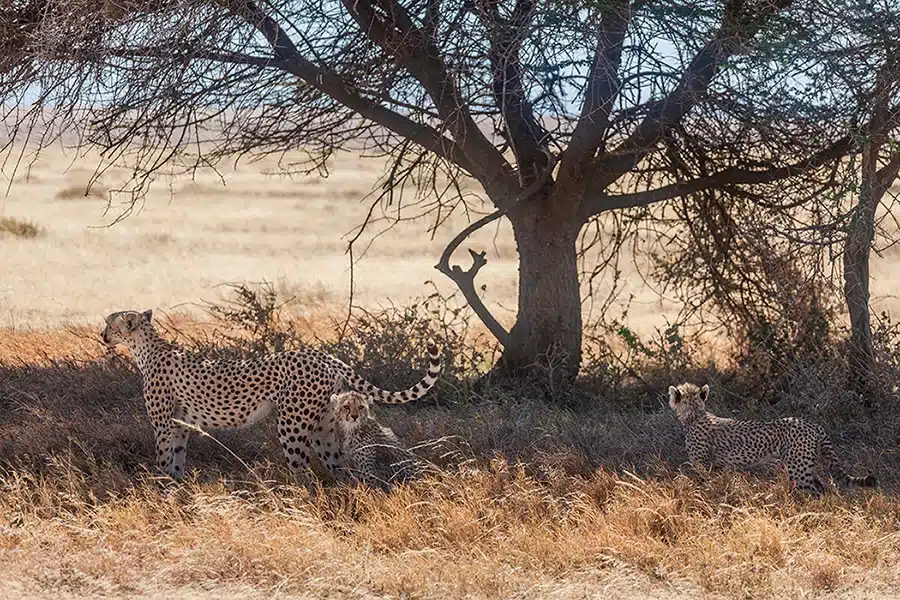
The cats. Cheetah are the February animal, and there are two places to look for them. On the calving plains they hunt in daylight on short grass, which is the condition they are built for. In the central eastern Serengeti, Soit Le Motonyi has probably the highest density of cheetah in the whole park, and that has nothing to do with the season. Lion are on the crater floor in prides of 60 to 70 animals, and resident at Soit Le Motonyi in every month. Leopard wants cover rather than open plain, so your chance is in the acacia woodland of the central east and in the riverine bush in Tarangire.
The big bodies. Elephant herds pass the Lake Burunge corridor in Tarangire daily, and there are elephants on the crater floor and in the Lake Manyara forest as well. Buffalo graze in large herds in every park on the circuit. Black rhino is the one nobody can promise, in February or in any month, and the Ngorongoro Crater is where your chance is. Giraffe are across the circuit and absent from one place only, the crater floor, because the steep walls and short grass do not suit them.
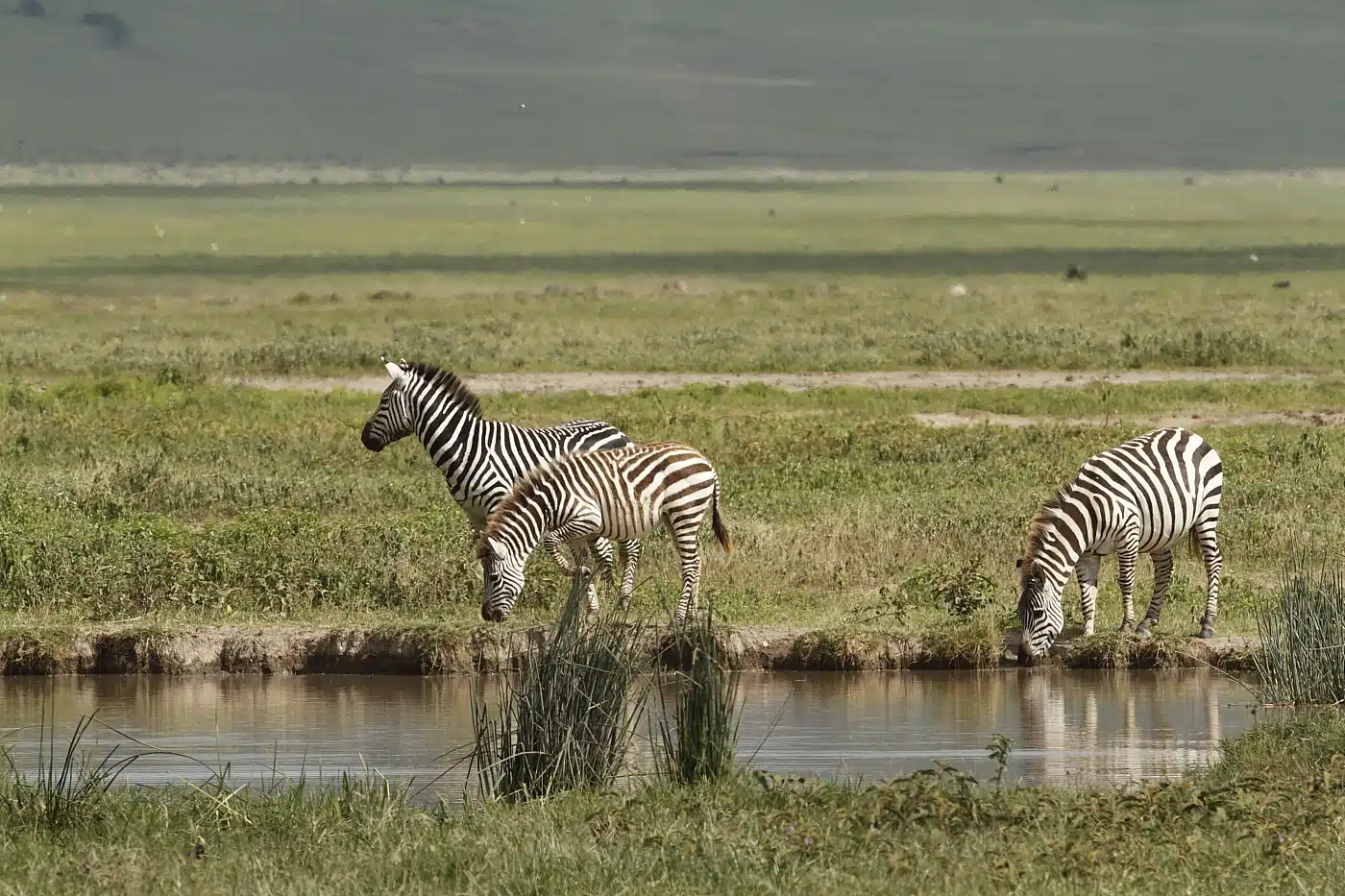
The ones that do not make the brochure. Lake Manyara carries hippo, olive baboon and blue monkey in the groundwater forest, along with the tree climbing lions it is known for. Around Ndutu you also get zebra and gazelle moving with the wildebeest, plus giraffe, impala, dik dik, spotted hyena, bat-eared fox, genet, jackal and wildcat. Tarangire is the one park on our routes where African wild dogs turn up, and they turn up rarely enough that nobody should build a trip around them.
A note on the two cat bases. Ndutu and Soit Le Motonyi are about two hours apart, and they give you different animals. The plains give you the hunt in the open. The woodland gives you the leopard and the permanent water, because the underground Ngare Nanyuki River keeps pockets of it in front of Mawe Tented Camp all year. A February week with both in it is a better week than a February week with one. More on the area is on our Soit Le Motonyi page.
Families should know what the calving looks like before they book. Calves are taken in daylight, at close range, and the vehicle does not move away from it. Children who have been told what they might see cope with it far better than children who have not.
Tanzania weather in February
Tanzania in February is dry by green season standards, though July is drier still. The reason is the calendar rather than the sky. February is inside the gap between the two rainy seasons, so the storms that do arrive are short, they come in the afternoon or overnight, and they are gone by the time you leave camp.
TMA’s Climate Statement for 2025 put much of the country below normal rainfall that February, under 75 percent of the long term average, and the islands below normal too. That was one year and not a rule, and it does match the pattern TMA describes for the two-season areas.
How hot is it, and what will you be wearing
February is the hottest stretch of the year alongside January. TMA recorded the national mean 0.8°C above average in February 2025 and the maximum 1.0°C above, both the highest monthly readings of that year. What that means on the ground depends entirely on where you are standing.
Out at Ndutu you are on an open plain with almost no shade. The morning is mild and pleasant and you are warm by nine. By one in the afternoon the vehicle roof is the only shade for a long way, which is why most February days break for lunch in camp. Evenings cool down and the nights are comfortable.
At Karatu and on the Ngorongoro Crater rim it reverses. You want a fleece before sunrise and you will be glad of it in an open vehicle on the descent road. By the time you reach the crater floor it has come off.
The coast and Zanzibar are the humid part of the country in February. Hot through the day and not much cooler after dark.
How much rain February brings
The short rains finish around December. The long rains, which TMA calls Masika, start in March and finish at the end of May. February is inside the gap between them, which is why it is one of the two driest months of the green season.
TMA recorded 86.7 mm nationally in February 2025 against 212.3 mm in March 2025, which shows the size of that gap in one comparison.
That gap changes what you can do. Less rain means the black cotton soil on the southern plains stays firm, so your vehicle reaches places it cannot get to in April. It also means the grass has stopped growing fast, so you see across open country instead of into it.
Getting there, and getting around
Kilimanjaro International Airport is the way in, about an hour from Arusha, and it serves the whole northern circuit. From there the trip is on wheels, with one leg you can put in the air if you want to.
Arusha to Karatu is about two hours over 130 kilometers (81 miles) on paved road. From Karatu it is 20 minutes to Lake Manyara, 30 minutes to the Loduare gate and about an hour down to the crater floor, an hour to Tarangire and 45 minutes to Lake Eyasi.
Ndutu is the long leg. About two and a half hours from Karatu past the crater rim, about two hours off the rim itself, about two hours from the central Serengeti and about five hours from Arusha. Coastal Aviation also flies into the Ndutu airstrip, an hour and five minutes from Arusha or half an hour from the Lake Manyara airstrip, at $343 one way for an adult plus $32 in taxes and charges.
In February the driving is the straightforward part, because the plains are firm and the tracks are open. The bed at the other end is not. Ndutu is the busiest place in the country this month and the camps out there fill months ahead, so book the camp first and the transport second. If the plains are full for your dates, the central eastern Serengeti is two hours away and it is not full, which is the answer most people are not given.
The parks in Tanzania in February
Five places earn your time in Tanzania in February, and each earns it differently. We do not sell the southern or western circuits, so this is limited to the parks we operate in.
Ndutu and southern Serengeti
This is where February earns its reputation. The calving herds are here and the ground is firm, and open country means you spend your time watching instead of searching.
Gnu Ndutu Camp is open from late December until 31 March, which puts February in the middle of its season. It has ten tents and is one of our two seasonal camps, so it is out on the plains and not an hour’s drive from them. A double or twin is $286 per person per night, full board, and one rate applies across the whole season, so February costs what December costs.
Ndutu entrance fees, concession fees and seasonal campsite fees are collected separately by the conservation authority and are never inside the camp rate. There is more on the area at Ndutu.
Central and eastern Serengeti
The part of the park that does not care where the herds are. Soit Le Motonyi is where the southern short grass plains meet the acacia woodland, which is why it holds both the open-country animals and the ones that need cover, and the underground Ngare Nanyuki River keeps permanent water there through every month of the year.
For February that makes it the second half of a good week rather than an alternative to Ndutu. Two hours from the calving plains, resident lion, leopard and cheetah, and no dependence on an animal that moves. Mawe Tented Camp is there at $247 per person per night for a double or twin, full board, in the high season band.
Tarangire
February is not Tarangire’s strongest month, and we would rather say so than sell you the wrong week. The park’s big elephant concentrations build through the dry season, when the Tarangire River becomes the only reliable water for a long way and the animals come to it. In February there is water in many places, so the game is spread out.
February gives you space and birds instead. Tarangire in the green season carries large numbers of migrant species, and you will have most sightings to yourself.
Baobab Tented Camp is inside the park on the Lake Burunge corridor, where elephant herds pass daily. A double or twin is $218 per person per night, full board, in the high season band that covers February. If you are weighing this month against the dry season, our guide to the best time to visit Tarangire has the month by month picture.
Ngorongoro Crater
The crater does not depend on the migration. The Ngorongoro Conservation Area Authority says its wildlife is there in every month of the year. The floor supports around 25,000 large animals, including 60 to 70 lions in prides and one of East Africa’s last stable black rhino populations. Animals move in and out over the rim and enough of them stay. Giraffes are the animal you will not find down there, because the steep walls and short grass do not suit them.
That makes it the reliable half of a February trip. Whatever the herds at Ndutu are doing, the crater floor delivers.
Karatu Tented Lodge is 30 minutes from the Loduare gate and about an hour from the crater floor, a descent of 600 meters. A double or twin there is $130 per person per night, full board. That is why we use it for early starts. A crater day costs the same in February as it does in August, because the conservation area has no seasonal split.
Lake Manyara
Manyara is the birding stop, and February is a strong month for it. Tanzania National Parks records more than 350 bird species there, and the green season brings migrants in on top of the residents. The groundwater forest at the base of the escarpment is fed by springs and not by rain, so it stays green whatever the month is doing.
The park is about 330 square kilometers (127 square miles) and the shallow alkaline lake takes up close to two thirds of that, so the drivable ground is a narrow strip. Most people give it a half day rather than a stay, and it is 20 minutes from our lodge at Karatu. Lake Manyara has the rest.
Beyond the game drive in Tanzania in February
Three things are better in February than in most of the year, and one of them is only possible for another six weeks.
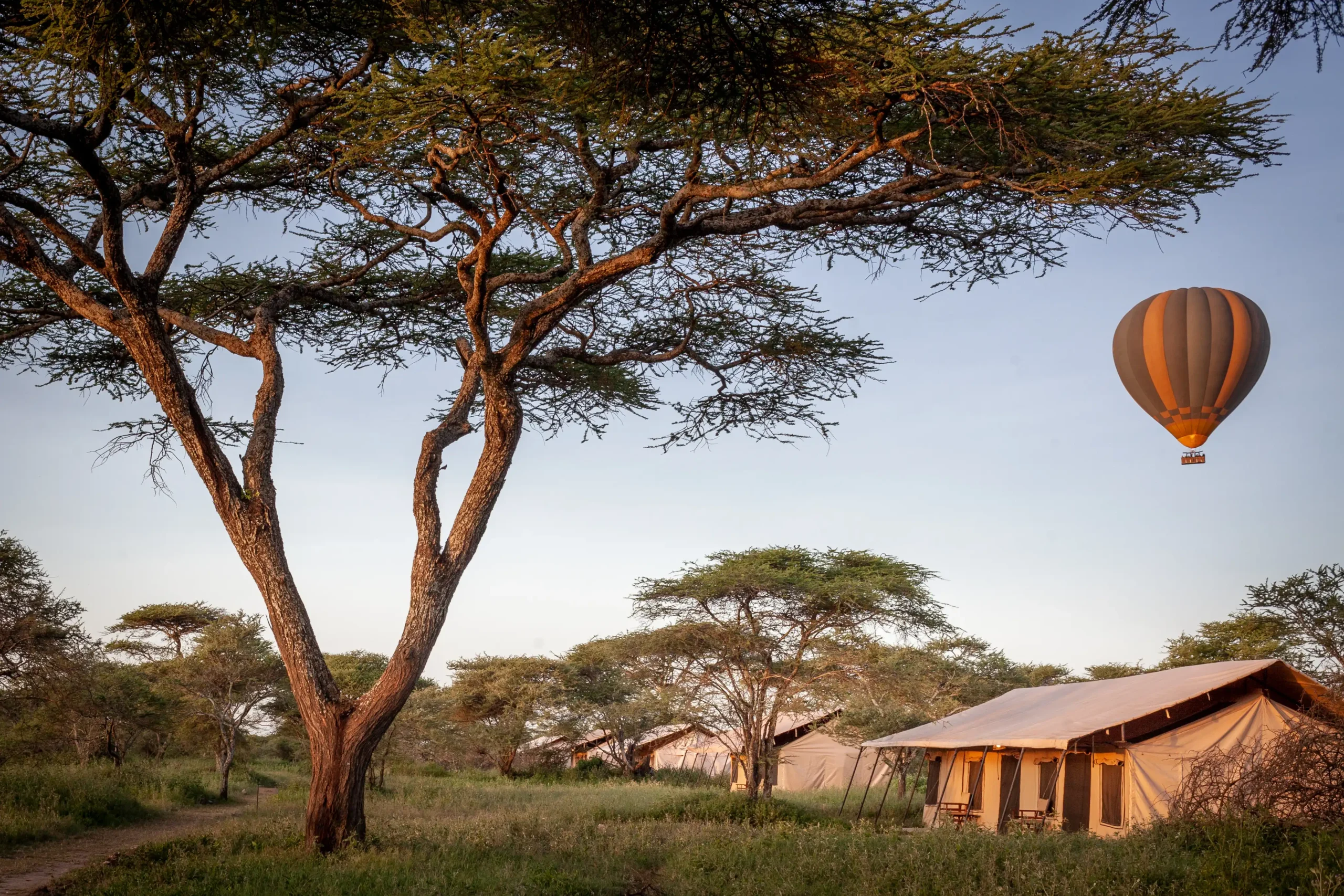
The balloon month. Ndutu launches run from late December to mid-March, and February is the part of that window with the most animals underneath it. Nowhere else in the year do you float over a plain with half a million newborns on it. The central Serengeti and Tarangire fly all year, a flight is from $599 per person covering the transfer, an hour in the air and a champagne breakfast, and children under seven cannot fly. Our hot air balloon page has the detail.
The firmest ground of the year to walk on. Our guides rate January and February highest for walking, because no route has been closed by rain and nothing is greasy underfoot. A bush walk is $80 per person for two to three hours and a half day is $180 per person for up to six hours. Walks leave from the Serengeti, from Tarangire, from the crater rim and Empakai, and from Karatu, and the walking safaris page sets out which is which.
The only park on the circuit that lets you drive at night. That is Tarangire, at $94.50 per person plus a $59 per person activity fee to Tanzania National Parks, for two to three hours after sunset. It is a different set of animals from the ones you spent the day with.
A day with no animals in it. Lake Eyasi is 45 minutes from our lodge at Karatu, where the Hadzabe hunt at first light and the Datoga work iron by hand, and the coffee estates toward Oldeani are closer still. On a trip built around one spectacle, a day that does not depend on wildlife is worth more than it sounds.
Which camps are open in Tanzania in February
Four of our five properties are open in February, and each one has ten tents or cottages. They are Gnu Ndutu Camp on the calving plains, Mawe Tented Camp at Soit Le Motonyi in the central eastern Serengeti, Baobab Tented Camp inside Tarangire and Karatu Tented Lodge on the escarpment.
Only two of our five properties are built around the migration at all, and the three that are open every month are not. That is worth knowing in the month when the migration is at its loudest, because it means a February route has a second half that does not depend on it.
The closed one is Gnu Mara River Camp at Kogatende, in the northern Serengeti. We open it on 1 June and close it on 15 November, because it exists for the Mara River crossings, and there are no crossings in February.
Crowds and costs in Tanzania in February
Tanzania in February is high season with us, 6 January to 28 February, and low season starts the day after.
You pay for the camp rate, the game drive and the park fees. The camp rate is full board and covers your room and your meals. The game drive covers the vehicle, the fuel and the guide. Park fees are collected by the park authorities and are never inside either of the other two.
| What you pay for | February figure | What it covers |
|---|---|---|
| Accommodation | $130 per person per night at the lodge in Karatu, $286 on the calving plains | Double or twin, full board, high season |
| Game drive | From $300 per vehicle per day | Private 4×4, guide and fuel |
| Ngorongoro entry | $70.80 per adult, plus $295 per vehicle | One entry within 24 hours |
| Serengeti conservation fee | $70 per adult per day, plus 18 percent VAT | Peak rate, which February falls inside |
TANAPA’s published tariff schedule puts the Serengeti peak season at 16 May to 14 March, so February is inside it at $70 for a non-resident adult and $20 for a child aged 5 to 15, both before VAT. That schedule was valid to 30 June 2024 and is still the most recent one TANAPA publishes, so confirm the current figure with the park authority before you budget. Tarangire is the one place where the official sources disagree, at $50 on the same schedule against $70 on TANAPA’s own Tarangire park page, and we use the park page figure. Park fees are paid at the gate or online, and they are quoted separately from everything else on your itinerary.
On crowds, Ndutu is the busiest place in the country this month, because everyone comes for the same three weeks. Tarangire and Lake Manyara are close to empty. The crater floor fills between about 9am and noon and is far emptier at dawn.
What five days in February adds up to
A February trip is usually Ndutu with the crater attached, and that route has a quirk worth knowing. Ndutu is inside the Ngorongoro Conservation Area, so a trip built on Ndutu and the crater never pays a Serengeti park fee at all.
Our five day trip is $2,114 per person for two people sharing, with a private vehicle and a guide throughout. Put two Ndutu nights and one crater day against that and the fees look like this, per person.
| Fee | How it is charged | Per person |
|---|---|---|
| Ngorongoro Conservation Area, three days | $70.80 per adult per 24 hours, Ndutu included | $212.40 |
| Crater service fee | $295 per vehicle, one entry within 24 hours | $147.50 |
| Serengeti conservation fee | Not charged on this route | Nothing |
Around $360, which takes the five days to roughly $2,475 a head before your flights and your visa. A Serengeti leg would add $82.60 for each day of it. Every fee is charged on a 24 hour clock, so the hour you enter a gate and the hour you leave it will move your total by a little. Ndutu also carries concession and campsite fees, which we quote against your dates. The nine day trip is $5,605 per person on the same basis, and the whole picture is on our Tanzania safari cost page.
Visa, health and insurance
The visa is applied for online before you fly, and a single entry tourist visa allows a stay of up to 90 days, with the fee depending on your nationality. Our post on how to obtain a tourist visa walks through it.
Malaria is present across northern Tanzania in every month. February is one of the drier months of the year, so mosquito numbers are lower than they are in the long rains, but they are not nothing. Talk to a travel clinic well before you fly. Whether you need a yellow fever certificate depends on the countries you pass through on the way rather than on Tanzania alone. Bring insurance that covers medical evacuation.
Events in February
The Kilimanjaro Marathon is on 7 February 2027 in Moshi, and the 2027 edition is the twenty-fifth. There is a 42.2 kilometer full marathon, a 21.1 kilometer half and a 5 kilometer fun run. Moshi is the town at the foot of Kilimanjaro, next to Kilimanjaro International Airport, which is the airport you fly into for a northern circuit safari anyway, so the two attach to each other easily.
One festival gets put in February by mistake. Sauti za Busara, the music festival in Stone Town, is on 19 to 21 March in 2027, so it is not a reason to book these dates.
Zanzibar and Kilimanjaro in February
Both fall inside the same dry gap between the rains, which is why February works for them.
Zanzibar in February is hot and humid and one of the drier months on the islands, with TMA recording them below normal rainfall in February 2025. We have no property in Zanzibar, so a beach extension after your safari is a partner hotel that we arrange and name before you book.
Kilimanjaro in February is in the middle of the first of the mountain’s two drier windows. We are not a trekking operator, so we would point you at a specialist, and our team can take over the day you come off the mountain.
What to pack for February
Pack for heat on the plains and cold on the crater rim in the same trip. Most people pack for one and not the other.
The February particular is a longer lens. The grass is low and the animals are spread across open ground, so you shoot at distance instead of through cover, and a dust cloth is more use this month than a dry bag. Bring a fleece for dawn at Ngorongoro and Karatu, and a light rain shell rather than full waterproofs. Sun protection matters more than usual, because the open plains give you no shade and the light off the short grass is strong.
Tanzania tours in February
A February trip is built around Ndutu with the crater attached, because the two answer different risks. The herds move and the crater does not.
Our 5-day Tanzania safari is $2,114 per person for two people sharing and the 9-day is $5,605 on the same basis. Both include a private vehicle and a guide throughout, because we own our fleet and employ our own guides. Park fees, international flights and visas are quoted separately. Start with the 5-day Tanzania safari route.
Who February suits, and who it does not
| If this is you | February |
|---|---|
| You cannot move your dates | Yes, and this is February’s real argument. Nothing inside the month changes, so any week you can get off work is the right week |
| You want the most animals you will ever see in one place | Yes. The densest three weeks in the Tanzanian calendar fall inside this month |
| You are bringing a long lens | Yes. Low grass, open ground, and cheetah hunting in daylight where you can watch the whole chase |
| You are booking late | No. Ndutu is the busiest place in the country this month and its camps fill months ahead. Book the bed before the flights |
| Your budget decides the trip | No. February is high season with us, and the calving weeks are the ones everybody books, so this is the month that asks most of your budget and gives you least room to negotiate on dates |
| You want Tarangire at its best | No. The elephant concentrations along the river build from June, when the water elsewhere has gone |
| You want a river crossing | No, and not by a few weeks either. The crossings are five months away in the far north of the park, and the camp we run up there does not open until 1 June |
| You have entered the Kilimanjaro Marathon | Yes. It is on 7 February 2027 in Moshi, next to the airport you are flying into anyway |
Frequently asked questions
28 February is the last night of our high season rate, and 1 March is the first night of the low one.
Check dates on our live availability calendar, or send your dates through the enquiry page.
Reviewed by the Mawe Lodges reservations team, Arusha.